
You walk out to your garden…
You anticipate green tomatoes streaked with hues of red, long green zucchini ready to pluck, and green beans begging to be harvested…
And then you spot them. Weeds!
The horror! Your hands itch to rip the nasty vermin from their root-clutching tentacles. How dare they take up residence in your yard and garden?!
I mean, a weed is a weed, right?
Well, kinda sorta. Before you tear them out, spit on them, and stomp on their graves — get ready for a surprise. Some of those pesky nuisances are edible! Here are 3 common edible weeds from the garden!
#1 — Lamb’s Quarters
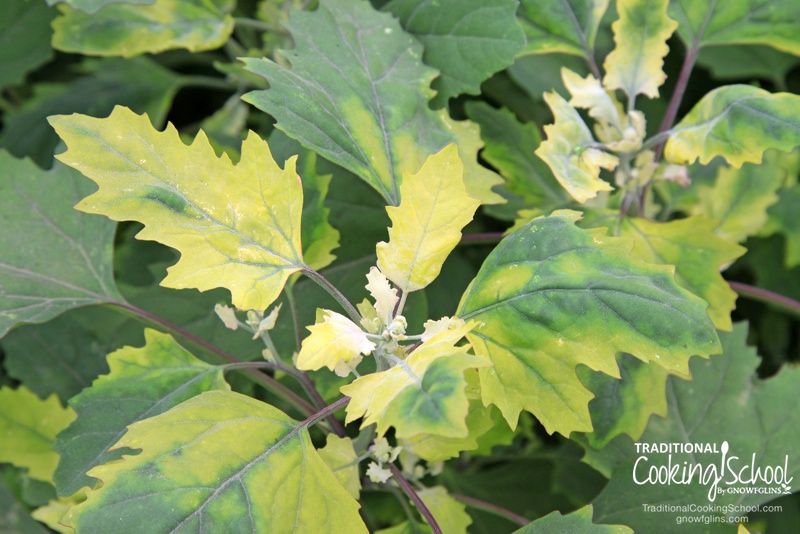
Ah, the common and unsuspecting lamb’s quarters. It will easily overtake a garden! And I used to relish demolishing it (insert evil cackle).
Then… One summer we went over to a new friends’ house. The husband, an avid gardener, showed us his garden. I’ll never forget how he reached down, plucked a few leaves of lamb’s quarters, and ate them without a 2nd thought — all while talking!
“Just like spinach,” he said.
Lamb’s quarters grow just about anywhere. In your yard, garden, roadside ditch, shady woods — even sunny, dry areas with bare soil. It drops seeds easily and propagates readily.
Look for triangular-shaped leaves with shallow teeth along the edges. When it’s young, look for a powdery white color toward the center of the plant, as well as the underside of the leaves.
If you want to taste it for yourself, pick the stem and leaves when they’re young and tender. As the plant matures, stick to the leaves.
Use as you would any other greens! We add it to salads, or stir it in a hot, oiled pan until wilted to then add to our omelets.
#2 — Sheep Sorrel
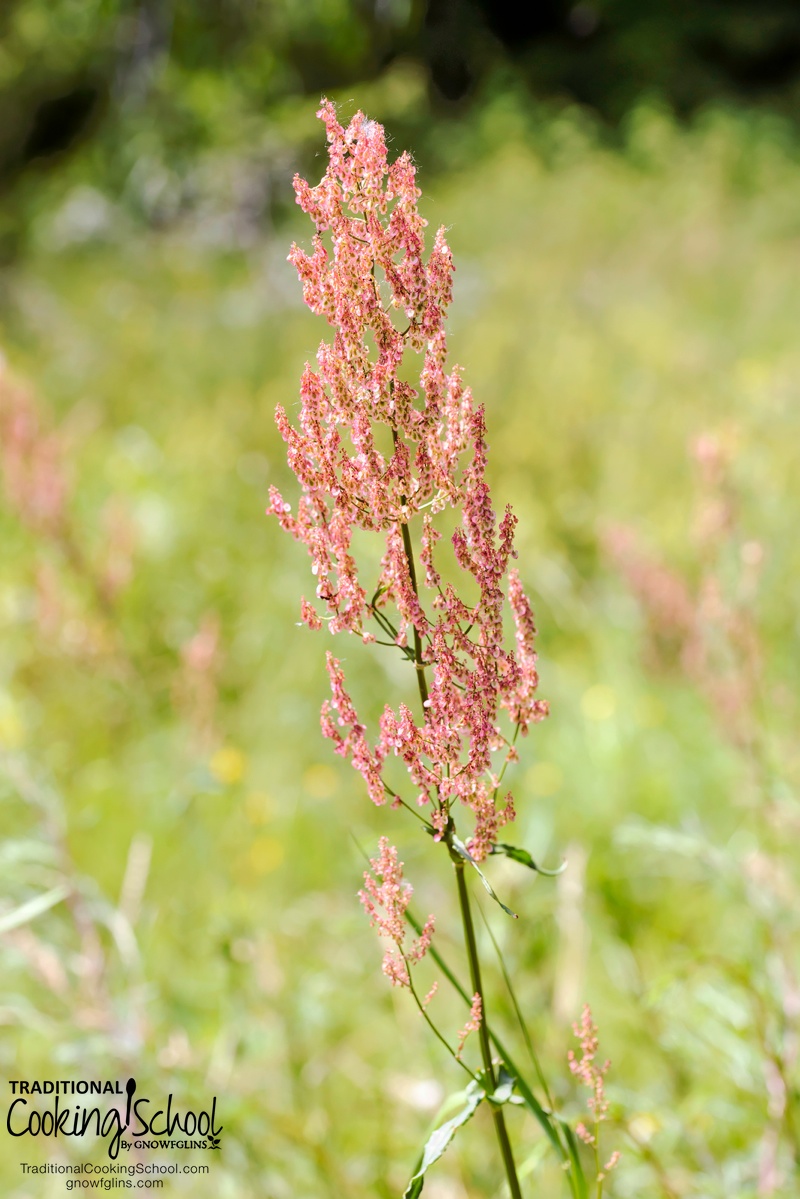
Sheep sorrel! Another easy-to-spot, common, “pesky” weed.
Like lamb’s quarters, sheep sorrel grows just about anywhere. It does like sandy or gravelly soil best, however.
Look for arrow-shaped leaves with little lobes toward the bottom. As they mature, they develop flowering stalks.
Pick the leaves only since the stems and flowering parts aren’t as tasty. In fact, look for plants that haven’t flowered yet at all. Their leaves will taste even better!
Sheep sorrel is surprisingly sour. But that gives soups, salads, and even rice dishes a nice, enjoyable twist.
#3 — Thistles
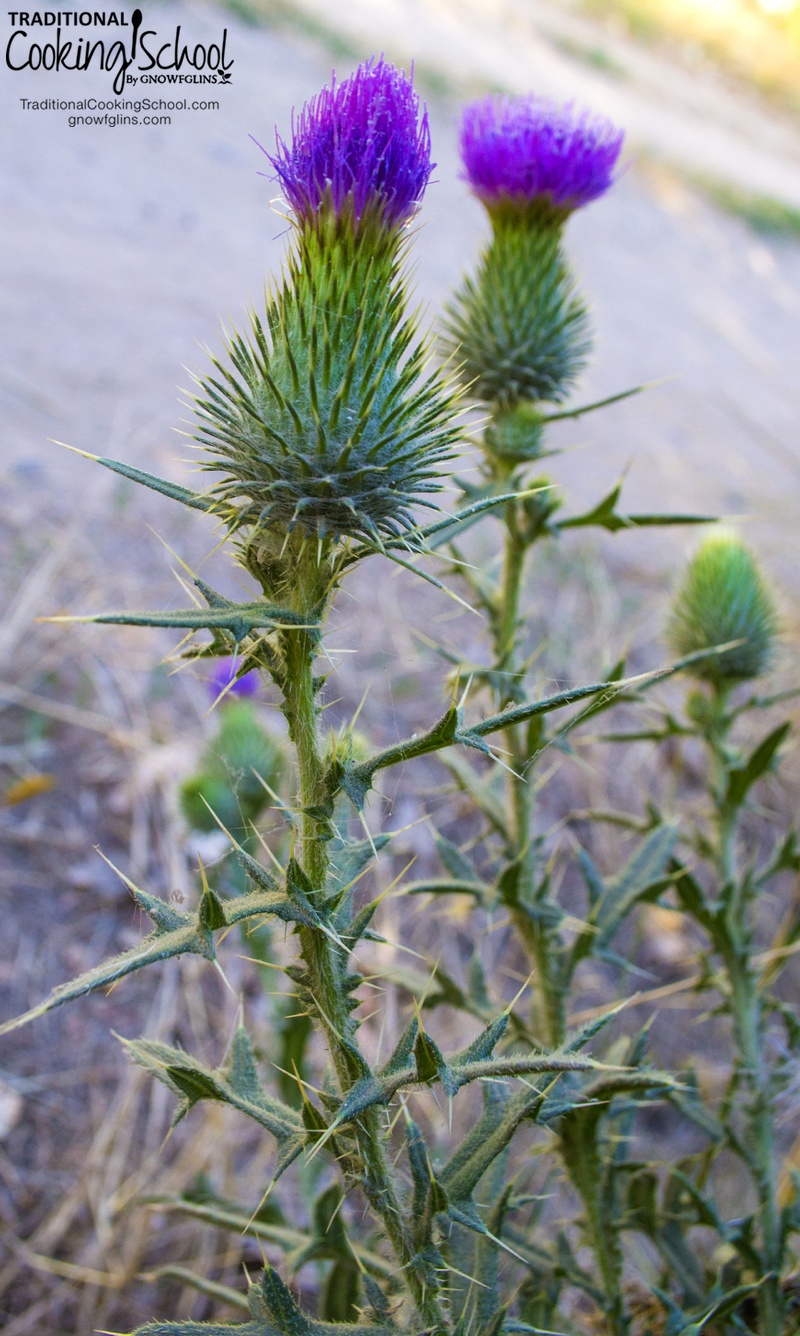
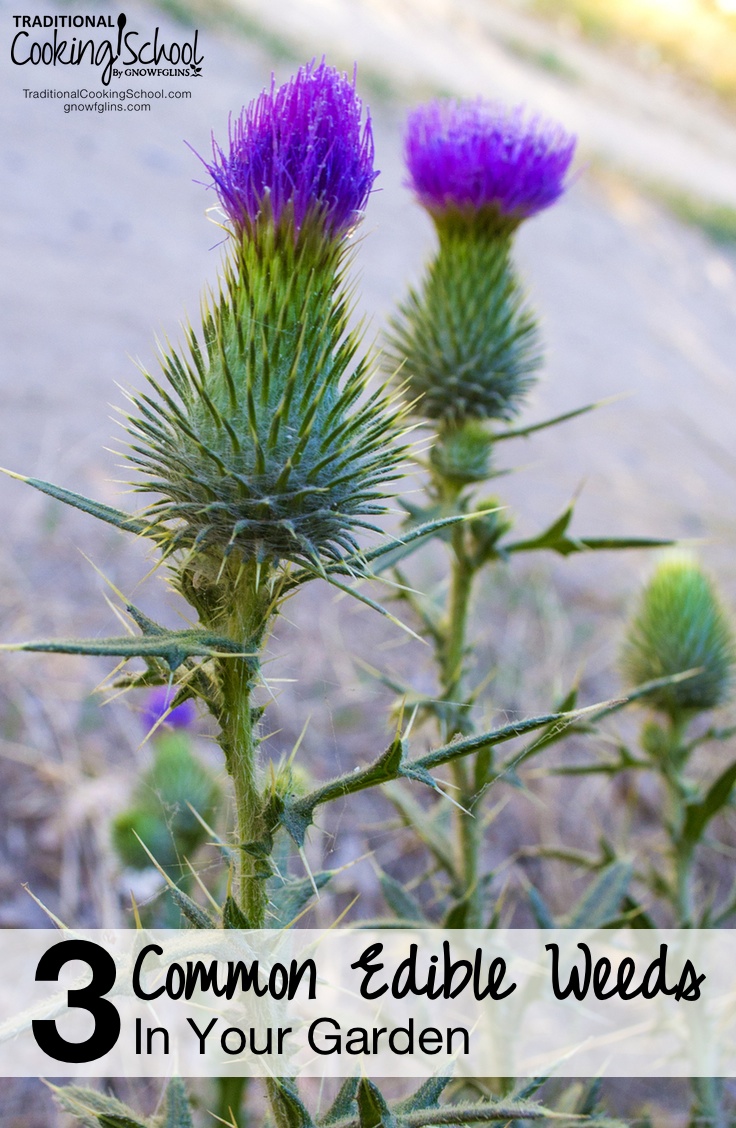
Thistle must be tried to be appreciated! 😉 The first time I told my husband about it, his look said it all:
“Yeah right, you want to eat thistles?! Is your throat made of steel?”
Turns out, the thistle midrib is the edible part. After carefully picking a leaf, hold it right side up and strip the leaves off the midrib — the white vein-like part down the center of each leaf.
It may take a little maneuvering, but the taste is worth it! I presented one to my husband, and even he was pleasantly surprised by their tender taste. He asked for seconds. And as any good cook knows, that’s a great sign.
Look for thistles by the rosette shape of their leaves, with a silvery underside, and of course — their thorns! If you run around barefoot, the thistle might find you first.
So… Next time you head out to mow the lawn, weed the garden, or take a drive, watch for these common “weeds” and stop for a bite to eat.
Do you harvest edible weeds from your garden? Do these common edible weeds grow in your garden or yard?
We only recommend products and services we wholeheartedly endorse. This post may contain special links through which we earn a small commission if you make a purchase (though your price is the same).


Nice article, Paula. I have heard that Lamb’s Quarter was edible but I never got around to looking for pictures of it. I’ve been pulling it up without knowing. I was wondering about thistle. The slugs really like to eat it in my garden. I wasn’t certain which part was edible. I am going to keep my eye out for Sheep Sorrel. I think I have seen it before in my yard but didn’t know what it looked liked. I also eat stinging nettle in the spring. I’ve never tried dandelion but heard they are edible to. Quite a few wild edibles in our yards that some pull up as weeds. Thanks for the info.
“Lambs Quarter” as some of us short spoken southerners call it, can be prolific and certainly is tasty. But it cooks down to nothing, so eat it raw. If you cook it, drink the juice it made, for there went the nutrients when the leaves disappeared. Might want to wash it to eat raw.
i have not eaten it raw – especially since the young buds have a sandy feel to them; i usually just steam mine or mix it with spinach and sauteed onions; just picked some today, might give it a try and toss it into salad greens.
Lambs Quarter, can be boiled or steamed. It goes well with pork and bamboo shoots. We the people of Arunachal Pradesh. India loves them.
What is the little clover like plant that is in the very first picture to the front right of the lamb’s quarter? I have always been told that this was sheep sorrel and have eaten it, but it doesn’t look like your picture of sheep sorrel. The plant I eat has small yellow flowers on it when it is full grown. Can you please clear this up for me? Thank you.
The plant with the little yellow flowers is WOOD Sorrel (or Oxalis) – I know, kind of confusing! Also edible, a delightful sour lemony taste.
I don’t remember what it’s called but a friend of mine taught me to eat the flower buds before they bloom. Tastes a bit like pickle and if I recall correctly is packed with Vitamin C.
Thoes are wood sorrel and you are right they are edible and quite tasty.
That is a wood or field sorrel. There is also one that has pink flowers and is found in the woods only. All edible.
I love biting the leaves of wood sorrel when they are still shut and haven’t quite opened yet – so tart and mouth-watering!
it is yellow clover 🙂 also known as sweet clover or deer clover
Sweet clover is an herb. The flowering branches and leaves are used to make medicine. Be careful not to confuse sweet clover with red clover.
Sweet clover is used to increase the loss of water from the body through the urine (as a diuretic). It is also used for varicose veins and to relieve symptoms of poor blood circulation (chronic venous insufficiency) including leg pain and heaviness, night cramps, itchiness, and fluid retention (edema).
Sweet clover is sometimes used along with regular medicines for treatment of blood clots in the veins.
Other uses include treatment of hemorrhoids and blockage of the lymphatic system. The lymphatic system drains fluid from tissues.
Some people apply sweet clover directly to the skin for bruises.
How does it work?
Sweet clover contains ingredients that can thin the blood and help wounds heal.
I have eaten sorrel, dandelion, plantain (that has taken over my backyard) I eat it is a salad or put it in my smoothies. Hey free is good as long as you do not use fertilizers and bug sprays.
Isn’t it great to have a nice snack on your walk across the yard? 🙂
Wow, thanks Paula! I did not know that these were edible. What I did know, and do eat is Dandelion. However can you or Rosemarie please explain Plantain to me? I know this to be a fruit like Bananas, but did not know there was and edible weed with the same name.
Here’s a picture of one: http://herbalacademy.herbalacademyofn.netdna-cdn.com/wp-content/uploads/2013/07/IMG_0071.jpg
Purslane and dandelions. Both are good in salads.
And I’m finding all of these at my house. There’s plenty of lamb’s quarters growing with the tomatoes!
Which gives us one more good reason not to weed the garden, right? 🙂
Poke Salad here in the south. Cooked up tastes like fresh spinach.
great info. just wondering: the thistle – do you eat it raw or cooked?
thanks
So far I’ve only eaten it raw, but you can eat it either way.
thanks!! we’ve got a bunch. i’ll give it a try. (though i might have my husband pick it!) 🙂
How do you not get stickers in your mouth? I know what they feel like when you step on them, OUCH!
You don’t actually eat the leafy part with stickers, instead, peel the leafy part with stickers away from the ‘rib’ down the middle.
I’m so excited to learn that about thistle leaves! We studied eating thistle a few years ago and learned about another part, the tender stalk early in the year. I was like your husband, except I compared thistle to “dinosaur food”! I mean, you can’t even touch the plant without getting poked…except on the flower! If you grab the soft purple flower (ours are purple here in Ms.) you can bend the entire stalk over. Then you slice though the stalk at the bend … but not all the way through. The inside is hollow, so you just pull the stalk away from the bottom of the plant and the part you didn’t slice through will peel off. Then you keep peeling all the way around until you have a thing that looks kind of like peeled sugar cane and kind of like celery. The taste is more like celery though… I was told by a local that it’s also called “poor man’s celery”. Pretty good with some peanut butter and raisins! 🙂
i am really excited to learn about thistles!!! i assume you are talking about the milk thistle, the one that gets the purple blossoms? and you eat them raw?
Sure would like to know about milk thistle as well! I take it every day in pill form for my liver. If I could grow my own that would be fantastic!
I eat both the tall milk thistles, and the ones close to the ground.
Sheep sorrel is also one of four ingredients in Essiac tea…used to dissolve cancer tumors.
We have a bunch of nettles in our yard as well. Nettle quiche anyone? Delicious. And if you get a nettle sting while picking them, a chewed up plantain leaf stuck on there wil give you relief in seconds…also works on bee stings, ect. We love our ‘weeds’ around here.
Our favorite “weed” is Chickweed. It grows all over (especially in empty garden space) in winter and spring (which gives it an added virtue :)). It is very mild and goes great in salads!
I haven’t tried chickweed – I’ll definitely be looking that one up. 🙂 This is me mowing our ‘weed infested’ yard today. “Think of all the food I’m wasting!” LOL
Chickweed is supposed to be a good appetite suppressant, too.
WOOD Sorrel . . . . glad to know the official name. Since I was a little girl I’ve always known it as “Billy Goat Grass!” Used to love to chew on it as a little girl!
We love stinging nettles – we dry then for tea and eat fresh in nettle pesto, nettle lasagna, as greens…Cooking or blanching destroys the sting. They are also very nutritious!
I love wild greens. I pick plantin, dandelion, lambs quarter, white top, poke, narrow dock and milk weed. I wish I could find some purslane, and will be trying the nettles. I pick mine, clean them of any debris, wash them, soak them in cold water for a day or two, changing the water, 2 to 3 times a day. Then I put them in a cooker and pareboil them. Drain them, add fresh water, salt pork, smoked jowl or pork hocks, salt and cook until good and tender. Quite tasty with homemade bread or corn bread. I have been eating these things since I was a child. My grandmother, grandfather, mother and father picked them. I am glad they passed this knowledge on to me. My oldest son who is 28, recognizes some of the wild greens as well. We usually have our first ones around April 21, my niece’s birthday. She and my youngest son like them too. She is 33 and my youngest son is 25. I have a new friend I met this year and she and her husband wanted to try them, so I cooked some for a church dinner, everyone like them, I didn’t bring any back home that is for sure.
Doletta, i’d be happy to send you some purslane seed! it grows literally all over my garden and i let it grow, it is way more than i ever use! it reseeds itself! but now is not the time for seed any more… contact me if you want some! may be you can get me some stinging nettle seed in return? 🙂
The young flowering stems of Sheep Sorrel (before they get tough) are yummy. Growing up we chewed on them frequently (chew, suck the juice, spit out the pulp). They were like sour candy to us. The older folks in my family called it Indian Cane. They do look kinda like miniature sugar cane.
I saw a green plant growing so well in my garden. I looked closer and saw it was garlic mustard. Very invasive here so I had to pull it and throw it in my stir fry.I just read that you can sprout lambs quarter seeds.
Add plantain to the list. Had some chopped and on top of my potato soup the other night. It has a good flavor.
Some farmer friends of mine sell Lamb’s Quarter at the farmers market for $8/lb.! We have so many we feed them to our pigs, chickens, rabbits, etc. We have a magenta variety that is beautiful. We eat dandelion, chickweed, sorrel, wood sorrel, plantain, wild blackberry, violet, nettles, dead nettle, amaranth (pig’s weed), wild grape leaves and more. Most of these have medicinal value as well as being good companions in the garden.
Hi Wardeh and everyone,
I also use and cherish the plant you can see in the photo behind the sorrel, which is yarrow. A few (and only a few) leaves added to an omelet or a salad are really yummy. Leaves can also stop a bleeding (which may be useful while gardening). Besides, a herbal tea of yarrow flowers will soothe stomach ache ( be it digestive or menstrual pains, sometimes you don’t really know which one it is anyway )
I keep looking for lambs quarters in my garden but all I keep finding is night shade. I do have a nice patch I’d sheep sorrel and some Lovely purslane growing amongst the tomatoes and peppers.
Purslane is a recent discovery of mine. I have several large plants growing in my garden. We have eaten it raw, used it in salads, and I even recently made purslane relish. Yum!
Do you have a recipe for your relish ? I do have plans to dehydrate some and add it as a freen powder to my smoothis this winter.
Oh, I was very excited to find one tiny lambs quarter plant in my garden this morning. There are plenty of seeds on it so I will plan to mtiply…
I bought a purslane flower at Home Depot with pinkish flowers. It has a tart taste. I saw the wild weed is yellow. Anyone know if this one eatible. I don’t have any wild purslane in my yard.
I would not eat that – since it is not cultivated to be an edible; though it may well be, stick to the weeds! We just redid our whole garden and mulched heavily, I forgot about the purslane 🙁 hope some will survive!!!
We put wood chips in our garden, about a foot of them, and I still have purslane 🙂
Hello-
Here in Maine we eat lambsquarters, dandelion greens, purslane, amaranth, fiddleheads, and wild mustard. I dry raspberry leaf to make tea. I use lambsquarters to make spanikopita, and I dry both amaranth and lambsquarters to add it to soup in the winter. I was thinking of pickling dandelion greens to give it a try.
Poke is delicious when it is young in the spring time. Don’t use old mature leaves. You do need to blanch it (bring to a boil) and pour the water off and then cook several more minutes. I like to scramble it with eggs! Every bit as good as spinach!
What a lesson this has been for me!
Thank you.
As a kid, I loved watching the horses eat thistles. They would roll those big horse lips back and oh-so-delicately munch that purple flower, eyes closed in bliss. When I was first given an artichoke I knew how those horses felt! Now I have to go scavenge some thistles!
I live in the Willamette Valley, Oregon, and I don’t think I’ve seen Lambs Quarters. Dandelions are too bitter for me, but I leave them if they aren’t in the way of another plant I want more. My tortoise loved them. As a child, I remember just sort of grazing my way across the yard. Ah, the era before pesticides!
A FB post described a plant as a “Plantain”, which is supposedly edible.
I have lots of what I thought were these plants around our property – the leaves tasted pretty good and didn’t kill me… yet.
Posted a picture of them on Plant ID page and they tell me that it’s Maianthemum canadense (Canada Mayflower).
Later confirmed via online search that they are edible and have similar medicinal applications to plantain.
IMHO the leaves taste a lot better.
Also have a purple comfrey bush, the blossoms of which are quite a delicacy and the edible leaves have a slippery sap with similar healing properties to that which is found in aloe vera.
I can see – looked up your plant 🙂 – why they thought it is plantain: the leaves alone look similar; however the leaves of this Canada Mayflower grow up on a stem where as plantain stays in a rosette form on the ground – I find plantain leaves rather plain tasting, never saw this other plant (may be we live too far south). Love plantain to treat itches and stings though! Made a plantain oil this year and it works well.