
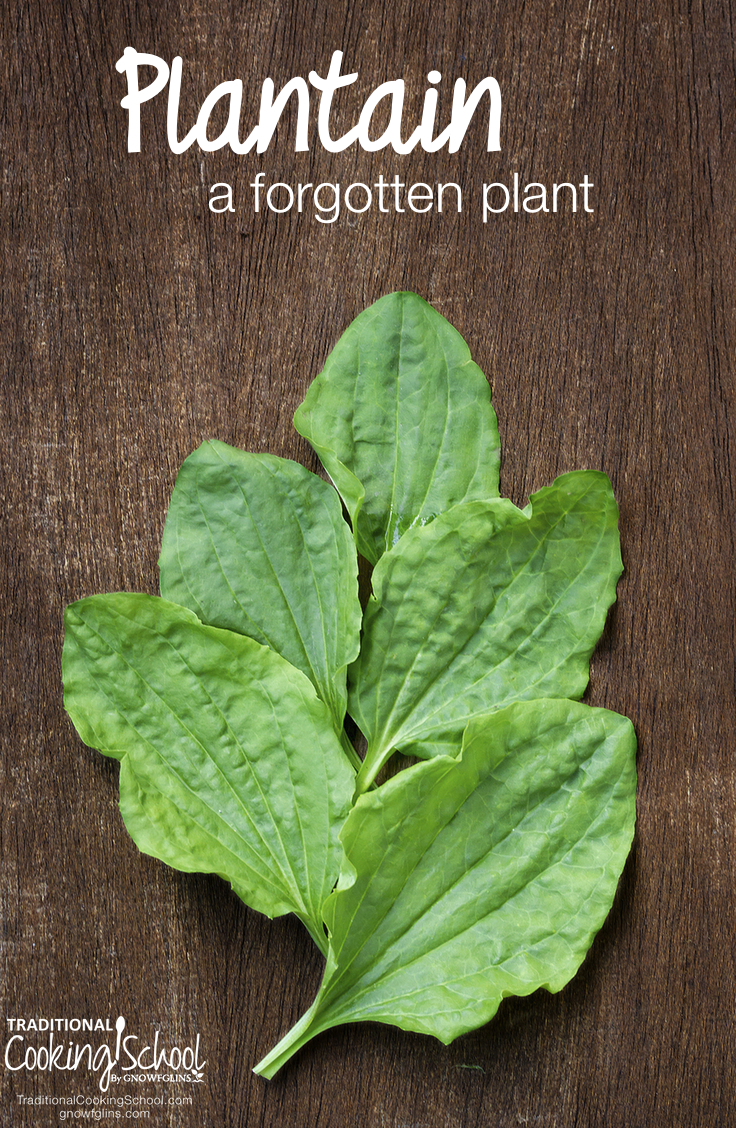
Before I learned what it was, I must have pulled at least a hundred of these plants out of my garden each year…
Can you guess what it is?
Plantain!
When I discovered how important and useful it is, I jumped right out of bed (where I do most of my reading 😉 ) and excitedly ran to tell my husband the news. Now, instead of throwing it into the compost pile, I can put it to good use in the kitchen or medicine cabinet.
This is the 5th post in our Forgotten Plants series — plants that were once prolific in the kitchen gardens of our ancestors, but now are so rare that the average person hasn’t even heard of them. Many of these plants deserve to find space in our gardens again!
History
If you’re familiar with the story of the dandelion, you’re familiar with the story of plantain, too! They share very similar histories.
Plantain was so useful and important to Europeans that they brought it with them when they came to the New World. Hundreds of years later, plantain grows prolifically just about everywhere. However, few people know what a medicinal and nutritional powerhouse they have growing right in their backyard.
What are a few of plantain’s historical benefits?
Reportedly, Alexander the Great used plantain to cure headaches while the Anglo-Saxons listed it as one of the “9 sacred herbs”. And, texts as early as the 1500 feature it in relation to medicine and healing.
In North America, folks commonly grew and used it until the 20th century. Then, urban life and modern medicine took over, and the plant was largely forgotten.
Planting & Harvesting
You probably don’t even need to plant plantain, as it grows naturally just about everywhere. If, however, you want to add a dedicated patch of it to your medicinal herb garden, it can be grown from seed and prefers a sunny location.
Plantain is as easy to harvest as it is to grow. The leaves are used mostly commonly, and can be harvested at any time during the growing season. Young leaves are best for eating, as older ones tend to be tough and fibrous.
Benefits
Plantain is antibacterial and anti-inflammatory — making it excellent for healing wounds. It takes the sting out of bee stings and the itch out of insect bites. In fact, check out our Homemade Bug Bite Stick, featuring plantain!
It also helps control bleeding. It stimulates the liver and purifies the blood. German researches have discovered that it is useful in healing certain lung conditions, including asthma and bronchitis. And according to Medicinal Herbs by Rosemary Gladstar, it can be used to draw out slivers that are too deep to pull out.
Nutritionally, it is similar to dandelion: loaded with iron, B vitamins, Vitamin C, and Vitamin K.
So how can we use this amazing plant?
Use #1 — Plantain Poultice
A poultice is perhaps the easiest way to use plantain. Collect the leaves, chop them, mash them a little, and place them over the cut, wound, bite, boil, infection, splinter, or sting. Then wrap with a cloth to hold in place.
Medicinal Herbs by Rosemary Gladstar states that the poultice may need to be replaced with fresh leaves every 30 minutes or so.
Like most herbs, you can also turn plantain into teas, tinctures, salves, and oils.
Use #2 — In The Kitchen
Sauté plantain’s green leaves like spinach, or add them to a smoothie, or boil them to bring out the sweetness.
Plantain is, of course, edible raw — although its bitterness makes it unpalatable for most.
Have you ever used plantain?
We only recommend products and services we wholeheartedly endorse. This post may contain special links through which we earn a small commission if you make a purchase (though your price is the same).


Grandma picked cow greens from the pasture that I remember mostly as a mix of plantain, mustard and dandelion greens. She didn’t cook them. Bacon grease and vinegar were heated and poured over to wilt.
That sounds good, Karen! Thanks for sharing! 🙂
My grandparents did the same ting they called it wilted salad
Plantain grows in my yard (I even put some into my garden to make sure I had enough). If I get a mosquito bite while working in my garden, I chew a bit of leaf and lay it across the bump.
It also makes a great salve: http://thechickncoop.blogspot.com/2013/09/homemade-plantain-salve.html
I read a story recently of a woman who used the same method (chew and apply) for bee stings. Great to know it’s good for mosquito bites, too. And thanks for sharing the salve recipe! I pinned it and will definitely be making some next year!
In a pinch, chewed Plantian poultices can be applied to a venomous snake bite until the victim can receive medical attention.
There’s something called no-bite-me, it’s a natural mosquito, tick, and fly repellent that both works and smells better than the commercial spray! Seriously, I’ve been outside for 6+ hours on a humid evening and escaped with no bites.
If I’m correct, I think these are “doc leaves”… when I was growing up in England we would play outside and get stung by nettles all the time… Whenever we got stung we would forage about for doc (doctor) leaves, break them, and rub the green juice on our stings… Then get straight back to playing again!
Doctor leaves is the perfect name for this plant! I had no idea that it worked for nettle stings, too.
Hi Amanda, You are right about putting “dock” leaves on nettle stings, I have been doing that my whole life (Im English) but it is not plaintain. Dock leaves are mugh larger. http://www.theotherandyhamilton.com/2012/08/24/dock-the-lunchbreak-forager/
Yes, and plantain leaves work well for that too. 🙂
Your ‘doc’ leaves would have been ‘dock’ from the burdock plant. I’m from England too, and the burdock was what we would crush on when we got into the stinging nettles.
No doc leaf I. England is very different. It can grow to be a very big thin leaf.
I make a rub for my sore knee and other joints with beeswax, coconut oil and plantain. Gather the seed tops for selenium
There are just so many reasons to love this plant. Thanks for sharing, Mary!
Yay for selenium sources (enzyme precursors)!!! I didn’t know that, but you all DO know that plantain husks ARE Psyllium husks (your standard fiber supplement), right? Cool, eh?
I would like to use the psyllium for a bread recipe.Exactly how do you do this? The seeds? When they are brown? I just don’t get it.
I haven’t harvested psyllium (yet?) but you might find this helpful: https://raising6kids.wordpress.com/2013/07/21/part-2-plantain-psyllium/ Basically it seems that you need to harvest the seed stalks, dry them, remove the seed, then grind it. Then you can use it in your recipe.
I learned about the plantain this past summer taking a plant biology class. I had literally just pulled tons of these little weeds from my garden that week. This stuff is everywhere in my yard. I couldn’t wait to try it. A few weeks later my daughter had a bug bite that was itchy. I ran to the yard and got a plantain leaf. I chewed it up and then put the chewed up mush on the bug bite. Immediately the itch was gone. I used the plantain the rest of the summer. What an awesome little plant.
It’s amazing isn’t it? This useful plant grows absolutely everywhere and so few people know about it! I will definitely be using it for bug bites myself this coming summer!
We used plantain to cure our daughter’s tooth infection. Poultices of this amazing herb drew the infection right out! We also gave her golden seal tincture.
We use a salve with plantain, comfrey, calendula and something else I am forgetting in olive oil and coconut oil as an alternative to neosporin. It works wonders on cuts, scrapes, diaper rash, etc.
I grow calendula specifically for making salve, but I love the idea of adding plaintain and comfrey to it as well. I will definitely be giving this a try – thanks for sharing!
Katrina – I would be interested in your Neosporin alternative salve. Can you pass on your recipe or tell me where to find it? Also, how long does a salve normally keep? I don’t have kids, so we don’t use stuff like that terribly often but I would love to have it for when we do!
Is this the same plantain that have fruit that look like large bananas?
Hi Faithe, It’s confusing when two plants have the same name, isn’t it? The two are related in name only. The herbal plantain is a low-growing “weed” and does not bare fruit.
I make plantain oil by filling jars with the leaves and adding olive oil to cover and letting it sit for 6 weeks. Then I use it to make salve sometimes combining with calendula oil.
This is the same way I make and use calendula oil. I will definitely have to make some plantain oil next year. Thanks so much for sharing!
I have heard that making infused oils with fresh herbs (ie basil, rosemary, etc) can create botulism, that you need to dry the herbs first to remove the excess moisture or infuse the oil via the cooking method and then use it quickly. Is this the case with calendula and plantain?
Hi Julie, I haven’t heard that but did a little research and it seems that you are correct, there is some risk of botulism with infused oils. It seems that this is particularly a concern with culinary oils that you will be ingesting (but I imagine spreading botulism on your skin isn’t the best idea either….) Drying the herbs first will eliminate the risk, as will starting the process with clean sterilized jars, and storing the oil in the fridge when the infusion is complete. That being said I personally make my calendula oil with fresh flowers, as do most herbalists. Thanks for your question! It is definitely something worth looking in to.
On the subject of botulism, I thought I would mention something I learned earlier today (7/5/2014) about Pressure Canning, which is that botulism dies at 235 degrees
F or hotter; and that canning by burying food jars in water cannot kill botulism (if it is present) since the water only heats up to 212 degrees F (and when it completely covers jars, they also heat up only to the same degree as the water). What makes Pressure (Cooker) Canning different is that only about 3 Qts of water is added to the pot, which brings the water level up to about 25%-33% of the height of the jars. The next result is that steam “super heats”, which means that it gets hotter than boiling water, and it is that extra heat that kills botulism in canning jars (if it is present). Cooks know that water will start “steaming” before it reaches the boiling point. In the same way, captured and pressurized steam rises in temperature above the boiling point. This is well known and understood in certain HVAC water boiler heaters as well as steam boiler heaters. I just thought I would mention it since had never seen Pressure Canners in operation before, and I had just presumed that water (over canning jars) boiling in a covered pot was sufficient to kill botulism.
I’ve been told by my herbalist instructor to let the plant material wilt for an hour or more before putting it in the jar. Also, that fresh plant material is more potent than dried for use in oils and tinctures. Anyway, that’s what I do, and have never had a problem. But I don’t ingest the oil–I only use topically. Plantain is a favorite of mine! My husband is physical laborer and is always injuring himself, so he keeps a jar of salve on hand, which he quite often gives away to coworkers who get hurt! Works great on sunburn too!
Here’s another trivia tidbit about plantain: the seeds, when mature, are none other than the famous PSYLLIUM, aka., that fiber supplement stuff: a powder with amazing power to absorb liquids AND makes a pretty good juice jello when you’re out of gelatin. 🙂 In a pinch, you can use psyllium powder for the same medicinal uses as the leaves.
My chickens love to eat both, and I don’t mind throwing young leaves in salads and smoothies. A chewed leaf (or other poultice or salve made from plantain) really does work WONDERS on anything that itches.
Excellent! I am loving this. I work with plants for a living and I never knew this. I have this plant all over my yard and look forward to sharing its benefits with my family and friends. Thank you!
Is there any other plants that are similar enough to be mistaken for the plantain in Michigan? I seem to be gifted with an abundance of what looks like plantain in my country “lawn.” I just want to make sure I do not to harvest the wrong plant since I am new to it. Thanks for any help you can offer.
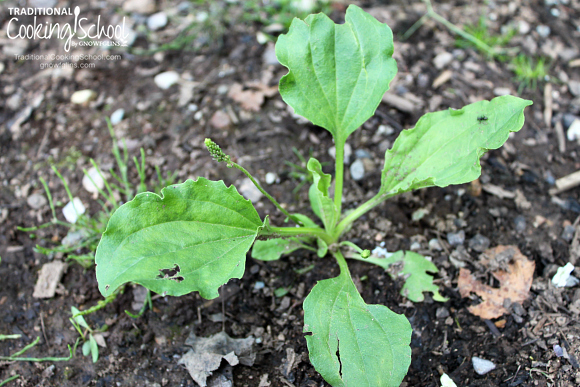
It’s a good idea to google some images and get some confidence for yourself, but all I have seen and read suggests that the veins all coming up from the stem (as opposed to coming off a central stalk) are a fool-proof sign. The most common plantain herb has a seed stalk that comes up the second year and grows hundreds of tiny black seeds inside little brown shells all up and down the rattlesnake’s tail-looking stalk(s) growing from the center. There’s not a poisonous look-alike for those seed stalks (which, by the way, are the famous psyllium, which many fiber supplements are made from) There are a few edible varieties that do not have the same flowers and seed pods, but they all have the leaf veins in common.
Although I am not a wild plants expert, from what I have read plantain is prolific and wide-spread, so it’s probably what you have growing in your lawn. One blogger suggests that if you slowly break the stem of a leaf and pull it apart slowly and the veins remain attached, then it’s plantain. This site mentions a few possible look-alike plants: http://www.herballegacy.com/Ahlborn_Location.html however, the flowers should make them easily identifiable. Hope that helps!
carol, I grew up many years in the country in Mich…………..my grandmother (who was raised in Ky.) knew all of the plants and what they were good for……….. I believe she referred to the plantain as “pig ears”…………I miss her wisdom……….and I’m afraid that I didn’t pay enough attention to what she tried to teach me…………all those “old fashioned” ideas………what I wouldn’t give to have that knowledge now!!!
I use a plantain salve for bug bites-it does a great job. I have also used the spit poultice for a bee sting. I could feel it drawing out the poison! Unfortunately it didn’t alleviate the pain. I probably should have reapplied a few times though. I love plantain!
interesting I was eating the seed stems that I lightly cooked in butter on the iron flat skillet…good stuff.
My mum used to boil plantain with barley every few months and told us to drink to cleanse our kidneys!
Her god-son was to have surgery for kidney stones in a weeks time but after drinking everyday for 5 days, stones were broken up and passed out in urine………was not operated and is in his 70s now!
Wow, Rose! Sometimes Mum really does know best! 🙂
This is so old that I’m sure I won’t get a reply, but I wondered when I read this, the plantain leaves or the seeds? And the barley grass or the seeds/grain? Fascinating folk medicine.
Hi Krista. I think that she probably used the leaves instead of the plantain seed. But this is what I found about barley: barley seed is used for lowering blood sugar, blood pressure, and cholesterol, while the young barley grass is used as a supplement for boosting immunity, improving digestion, and as a general health tonic. So in light of that info, I’d say she probably used the barley grass! I hope this helps! Blessings! 🙂 ~Dawn, Customer Success Team
My boss’s dad was severely burned decades ago. Modern medicine could not get the burns to fully heal. A healer told his wife to pick this plant and make a poultice and apply 3 times a day to the remaining wounds. They healed within a few weeks! Drew out the infection and pain. Great plant.
Thanks Andrea, for your article on plantago. I was excited to learn more of its history from your writing. I love this plant too! Every Spring I teach a class on salve making with this plant and other yard plants. My favorite way to use plantago is to pick it, dry it, infuse it in oil, then use the oil for a healing salve and as an ingredient in a muscle relief salve. I save the strained leaves and either bake them or sauté them. This way they are crispy and far more tasty than cooking them or eating them fresh, similar to cooking kale this way. I really enjoyed your article!
Thank you Lesli! I will definitely be trying out a plantain salve myself this year, and the crispy leaves sound wonderful!
You are correct, it is not the same as the dock plant proper. As a native of NJ, though, I can say that dock is just a local colloquial name for plantain that we have in the northeast. I knew it as that way before I got into wildcrafting and heard the name plantain:-)
I had just read about this plant in Rosemary’s book as well and wishing I had some growing in my garden! Went out to weed the herb garden the other day and guess what beautiful little plant was growing?! A plantain! Before, I would have yanked that baby out, now it received a cherished welcome! I’ve foraged some out of my brother’s yard and he thought I was nuts 😉 Your article was very helpful and appreciated. When harvesting the leaves, will more grow back during the season or will you only get what’s there once a year? Trying to figure out how many plants I actually need.
Our lawn is mostly plantain (not on purpose, it just worked out that way) and it quickly grows back each time we mow.
My mother had an ulcer on the back of her leg due to an injury. Her legs had very poor circulation and it would not heal using all the natural remedies I knew. We heard about plantain and decided to give it a try. I crushed the leaves and made a poultice which I changed periodically. It was amazing to watch the progress as the ulcer healed. I am sold on the herb/weed. That was more than 10 years ago and I still tell people a bout it. I never thought to use it for a tooth infection. I will have to remember that.
I can attest for the blood clotting ability of plantain. My family was at a family outing-we took a walk in the woods. One little boy had a couple stitches on his finger and as preschooler’s will do, he picked at them. In the middle of the woods. Not one of us had a napkin in our pockets. So, I chewed a plantain leaf and applied it directly to the cut. I took a plantain leaf, wrapped it around the finger and told him to hold it for a couple minutes. When we checked it a couple minutes later, it had completely clotted! This is an awesome little plant!
Amazing! There is so much to love about plantain.
How embarrassing I clicked through because I thought it was about bananas! So happy I did though who knew this little weed was so useful and that phylum husk comes from it, utterly fantastic thank you!