
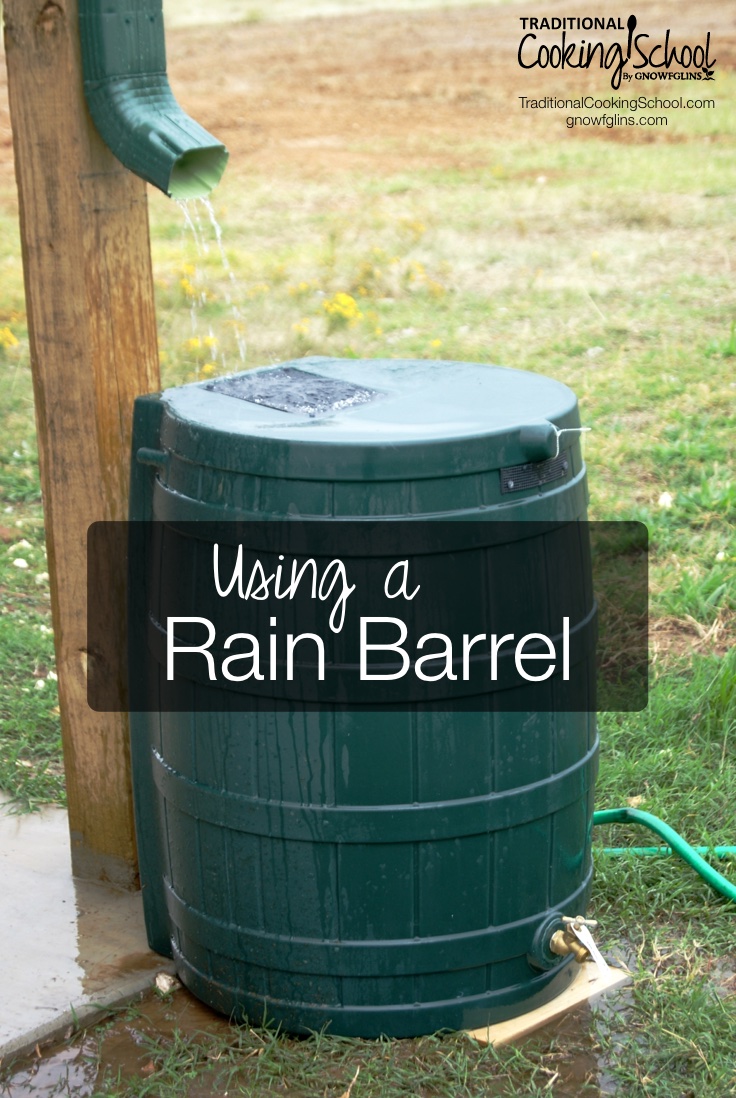
We purchased four green plastic rain barrels almost right away when we started building our homestead. We loved the idea of taking an extra step toward self-sufficiency and sustainability in our garden.
During the building process, our builder even made our gutters at a specific height to accommodate our barrels. We originally intended to have two for our house and two for our barn, but unfortunately, plans went awry and as a result we have one rain barrel at each of the four corners of our home. Nevertheless, the arrangement has still proven to be effective in reducing our water bill.
We learned however, that there are a few cautions one needs to keep in mind when collecting rainwater.
1. Rainwater can be toxic for drinking.
Since the water is collected from the roof, bird droppings and toxins from shingles and other roof materials can potentially end up in the water. Therefore, one should use caution when using it to water plants that are going to be consumed (such as herbs and vegetables). As a general rule, we use rainwater on ornamental plants only.
2. Some states may have some legal restrictions on harvesting rainwater and how it is used.
Before collecting and using rainwater, familiarize yourself with the laws in your state. If you are urban homesteading in a neighborhood, be sure to investigate any covenants or restrictions your homeowners association may have against rain barrels before you make the investment.
Shopping for a Rain Barrel
Rain barrels themselves can be as fancy as those seen in decorator catalogs or as simple as something you make yourself from materials purchased at a home and garden store.
While shopping around, here are some things to consider:
Material. While I have seen and coveted some beautiful (and expensive!) copper-like models, ours are plastic in the same color as our green gutter spouts and roof. They are functional and affordable while still being somewhat attractive.
Height. The water is typically collected from the roof through your gutter spout. Since most gutter spouts flow all the way down the ground you may need to adjust them according to the height of your barrel. Height, of course, will depend on barrel capacity.
Capacity. How much water do you need? This depends on how you plan to use it. We have four 40-gallon barrels, which has proven to be ample for watering our ornamentals and perennial bed.
Overflow. A surprising amount of water can accumulate during a single summer rain. Be sure you have an additional spout or grate of some sort to allow for overflow.
Algae and mosquitoes. Any time you have stagnant water sitting, this is going to be a problem. A browse on the Internet shows solutions ranging from mosquito dunks to goldfish. Our solution is to simply drain the barrels when we notice the water no longer runs clear. This has worked for us, hassle-free.
Water flow. My initial naïve expectation was that we could connect a hose to the spout and we’d have a strong and steady flow of water. This hasn’t been the case. There are numerous pumps and gadgets available to help effectively and efficiently get the rain out of the barrel, some of which we have tried. Still, my favorite method is to simply use the spout on the barrel and drain into a large watering can.
Do you collect rainwater? What are some ways you use it?
...without giving up the foods you love or spending all day in the kitchen!

2 free books:
Eat God's Way
Ditch the Standard American Diet, get healthier & happier, and save money on groceries...
We only recommend products and services we wholeheartedly endorse. This post may contain special links through which we earn a small commission if you make a purchase (though your price is the same).


My husband and his friend built a rain barrel for us. It is great except there is one pesky leak we can’t seem to figure out! Hopefully it will be fixed this year. The water is great for the flowers, but also for rinsing (non-edible) things. Our trees release a ton of large pollen and it gets on everything. Rather than waste clean water to rinse off the chairs, grill over, etc, we use the rain water.
That is a great idea Jackie to use the water for rinsing outdoor furniture. I hadn’t thought of that.
My sister “The Rhode Island Water Lady” sells complete rain barrels which are recycled food barrels (previously used to transport olives, capers, or vegetables from the Mediterranean).
You can access information on her many community programs at: http://www.riwaterlady.com/index.html
Thank you – Jack
Thank you Jack! Her barrels are gorgeous.
I am a Master Gardener and am known as the ‘RI Water Lady’ for my interest in rainwater harvesting and water conservation. Some of your conclusions and warnings are incorrect and I wanted to share the research that folks might find useful in communications with the public on the topic of rain-barrel water safety.
Here’s a blog post answering the question: Can I use my rain-barrel water to irrigate my vegetables?
A Green Light for Using Rain Barrel Water on Garden Edibles
And here’s that post turned into a brochure suitable for sharing with the public:
Advice on Rain Barrel Watering Now As a Pamphlet!
Hi Beverly, Thank you so much for sharing! And how nice to meet a fellow Master Gardener! 🙂 I served my county extension for six years and it was through them that I learned about harvesting rain water and from where I began to gather my information when we first got started.
By stating in my post that “one should use caution…as a general rule” I was hoping to convey that this is based on my *personal* experience and research. There is another perspective as you have shared, but I personally feel people need to know there are some cautions to consider when it comes to using rainwater on vegetables.
I’m so glad you shared this info so folks can further look into the matter for and decide what they feel comfortable doing. Best wishes on a bountiful harvest this gardening season!
I use my rain water for mixing cement when I have to fix a broken fence pole. Or when I am spraying the weeds.
last year i set up my first rainbarrel for the garden, put a faucet on it for when it gets low, but normally just bucket it out. i set up a piece of gutter under the greenhouse roof, and it goes in the barrel. this year i set up another barrel for washing the car, and perrenial beds out front, if needed…this year we are 8 inches below normal for rain, so they were very helpful.