
Like my free videos? Please subscribe to the Traditional Cooking School Channel on YouTube — and give this or any other video a thumbs-up!
Do you know why soy is pretty much universally used in chicken feed? It is an inexpensive source of protein and it helps chickens grow faster. But it isn’t very good for us. (You can find out why here.)
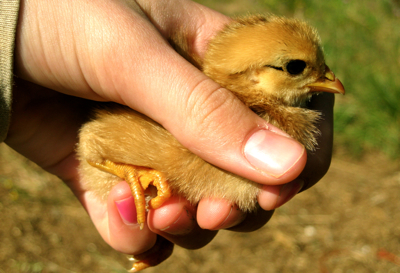
Perhaps you, like many others, are looking for soy-free chicken food. If you have a family milk cow or friends with abundant milk, I’ve got an idea for you. This week’s free video explains it to you, or you can read the short transcript below. Do try to watch the video, though, and see our brand-new surprise chicks! (That story is here on Facebook.)
On our homestead — in addition to bugs all over the place and a few scattered oats, sunflower seeds and whole peas — we give our free-range chickens clabber, or spontaneously soured raw milk. I put the extra of our abundant whole, raw Jersey milk in two gallon buckets or gallon jars and leave them at room temperature. In about two days the naturally present beneficial organisms have thickened it up like yogurt. I skim off the cream for us (check out the easy, easy sour cream video). And the thickened milk, otherwise known as clabber, goes to the chickens.
They love it and eat gobs of it — and they’re very healthy! We spread it on the ground when there are chicks around, so none of the babies fall into any big tubs. And then we have fun watching them eat it all up!
Do you have any tips to share about avoiding soy in chicken feed?
Want to learn more about raw cheesemaking? Check out a GNOWFGLINS membership which includes access to a complete Cultured Dairy & Basic Cheese module, including dozens of videos and print tutorials for everything from sour cream and yogurt to a variety of simple cheeses.
...without giving up the foods you love or spending all day in the kitchen!

2 free books:
Eat God's Way
Ditch the Standard American Diet, get healthier & happier, and save money on groceries...
We only recommend products and services we wholeheartedly endorse. This post may contain special links through which we earn a small commission if you make a purchase (though your price is the same).


my question is… What breed of chicken is that?
The Mama hen? She’s a black cornish and white rock cross.
My chickens love clabbered milk!!!
She looks good enough to eat! ha ha
Thank you so much for the tip!
If anyone is interested there is a company called scratch and peck feed in seattle. They have soy free and corn free products available that aren’t processed into pellets. You can see the grains, fish meal, oyster shell, peas, etc. We have a store in Spokane that stocks it. Also, tropical traditions will sell you their cocofeed, you have to email them for details.
There is a drop point in Vancouver , WA (Camas) and a store in Beaverton that carries scratchandpeck.com feed as well.
Please tell me if the drop point in Camas, is still running. I’m very much interested in purchasing the scratchandpeck product! I see this post was from 9/11
We have access to raw milk and my chickens must be spoiled. ..they don’t drink much of it.
I will then strain off the whey and ferment their feed which I understand increases not only digestibility but also the protein content. They love this fermented feed (I buy feed/grains from Azure Standard who sells the scratch and feed mentioned above).
Thanks, Cheryl!
We are very much a “micro” farm. We have goats and chickens on our little half acre. Unfortunately we are unable to free range at this time – though, hopefully by next summer. In the mean time we buy the Rogue brand of soy free layer feed from Azure. This, though, is quite costly. We are having to downsize our flock due to the expense of feeding them. I’d love some soy free ideas for those that can’t free range full time. Also, any ideas for soy free meat birds would be appreciated too.
Debbi — I’d suggest looking into raising worms. There are some really cool ideas on the internet and one in a back issue of Countryside magazine (I don’t remember the issue).
Another idea is whey — lots of protein. If you make any kind of cheese, you can feed the leftover whey to the chickens.
Debbi-we buy individual ingredients for our hens from Azure and mix our own feed. Right now they’ve taken the barley off the site, and the corn is out of stock, so the timing isn’t good, but this is what we get and mix. organic bulk corn, organic barley (animal feed), organic oats (animal feed)-they come on 45-50 pound sacks. Those are mixed and a 25 pound bag of green peas from Azure is added to boost the protein level.
I’m currently looking for alternatives because of the outtages at Azure.
I’m assuming I could do the same thing with raw goat milk. Does it clabber as well as cow’s milk? Also, is the clabbered milk a replacement then for soy as their source of protein?
Laurie — Yes, you can do the same with goat’s milk. But — you’d lose the sour cream then it won’t rise to the surface (so well, though it will some) during the clabbering.
I feed extra milk to my chickens and turkeys too, clabbered or not.
I understand about not eating soy but I don’t understand why we can’t feed it to our animals? Isn’t that what it was meant for? Do the same properties transfer through the animal and then back to us when we consume them? Would it not change as the animal is digesting it? I mean, grass isn’t good for us to eat directly either but we drink the milk from an animal that eats it. I’d be happy if anyone could explain it to me. 🙂
According to the Weston A. Price Foundation:
And this is what is wrong with phytoestrogens (when we consume them at least):
And here:
But as the first quote mentioned, home grown chickens’ eggs (and meat, too, I would presume) contain lower levels of it than commercial. So if one can’t do without soy, this is still considered a healthy food except for the very sensitive.
I have the same questions as Marg. In our local WAPF chapter, many folks are looking for soy and corn free eggs and chickens, but when a local farmer posted asking why? , no one could answer if s/c is bad for chickens since they are omnivores. I have heard that folks who are allergic to soy or corn, cannot eat chickens that eat them, but does that apply to the rest of us? The chickens are sooo much more expensive when our farmers use s/c free feed, and they take a lot longer to grow. I wish we had more land to have animals, not yet though…..
what about raising meal worms or garden worms to feed to chickens for the protein? Isn’t that a natural source of protein for them? or raising some kind of insect?
Growing worms is a great idea and we’ve read about it in back issues of Countryside magazine.
Thanks for the video and information, Wardee. We used to have chickens (I miss them SO much– we can’t have them here). I long to be in a place where we can have both chickens and cows and a whole lot more, and I *love* the idea of using what comes naturally on the farm to tend to what needs tending-to on the same farm! The video was quite well done, too– I am impressed, and encouraged!
I buy a Soy & Corn Free pelleted layer feed that is made exclusively for Black Lake Nursery & Feed in Olympia, WA!!!!
Marg,
From what i’ve read soy was originally not even thought to be fit to feed to animals. It was planted as a crop to rejuvinate the soil or something, then plowed under (i’m not a famer but I know there is a more technical term for that, lol).
I view soy like I would view a poison. If I eat it directly, the effects are much stronger than if I eat an animal that has eaten it. But, I still don’t want to ingest it in any form, really. I need to bite the bullet and get rid of several of my salad dressings in fact….
We love your videos!!!! Since we don’t have the extra milk, we can’t do this often. But it would be great to give the chickens a special treat once and a while! I used to give our chickens kefir once and a great while and they loved it but clabbered milk would be easier.
Wardee, my farmer soaks his grain in the whey. The yokes are so orange and delicious! I am glad to see someone else is using this method as well! Is this expensive for other farmers to do? Because I keep hearing how most can not afford to switch over to non-soy feed because of the expense.
Jen — This would be expensive if someone were purchasing raw milk at regular prices. But if a person has their own raw milk (or knows someone who is just overflowing and gives it away cheap) it is not expensive. It is only as expensive as the feed for the cow. Soaking grains in whey is a great idea! Thanks for sharing what your farmer does.
Our yolks are as orange as they come, too — but that’s related to how much greens (carotene) the chickens get, rather than the amount of protein. In milk, it would be in the cream (of a grass-fed cow) — we skim the cream off so I know our chickens aren’t getting it from our milk. 😉
Very informative! Thanks!
I thought I should clarify: Anything green, orange, yellow, or red contain carotene, including corn. Orange yolks is one reason that corn is so often included in chicken feed.
Thank you so much for this….I have had a niggle in my heart for a while now about the laying pellets that we mix into the chickens corn. We do not have a large area for them to scratch so I always pick grass, collect snails from friends gardens and feed them other greens, but their main food is a mixed corn feed from the store. I have just callled them to find out if the pellets contain soy and yip they do. This now gives me anothe source of protein for our girls. Thanks again.
I learn something new every time I watch one of your videos! This one is really neat!
Thanks, Marlene!
Could you use kefir or some other fermented dairy?
I’m really looking for ways to make my own healthy chicken feed, so I love the clabbered milk idea – what else do you feed them? I’m hoping to be able to free range my girls soon (I need better fencing – if I let them out, they make a beeline for my garden!) but what do you feed them in the winter, when they can’t get green grass and bugs?
We feed our chickens a mix of organic ground black turtle beans, vitamins and minerals, and organic wheat. The mix is pricey, but it is both soy and corn free!
I love the scratch and peck feed. The last batch I got was corn free as well because the company will make special large batches and that is what the store wanted. My chickens love it – I spread it in their run like scratch and they are thriving on it. Very different from the pellets I had before. I know lots of people who use it (I live in WA) and all seem to love it.
how much is the going rate for a gallon of fresh milk?
Do you feed your chickens anything else? (Sorry if you answered this already and I missed it! How about in the winter? I’m already soy free, but I would like to be self sufficient and not buy extra feed or at least cut the cost of it. I have a Jersey cow with a heifer who needs to be bred yet, so milk isn’t too much of a problem around here, at this point. Thanks for the informative video!!
Hi,
This post is so informative. I would love for you to come
share it at FAT TUESDAY. I hope you will
put FAT TUESDAY on your list of carnivals to visit
and link to each week!
http://realfoodforager.com/2011/09/fat-tuesday-september-13-2011/
Are they good layers though? We have found when we don’t feed a balanced ration the egg production goes really low.
Marci — I wouldn’t say they are fantastic layers, no. They are pretty middle of the road. 🙂
Chickens are born with the number of eggs they’ll lay in their lifetime. “Good” layers will just lay them faster, not actually produce more. Just FYI.
my chickens are still pretty young and only laying for a month, but so far they are very consistent and consistent to what books said they would lay.
Thanks for linking your great post to FAT TUESDAY. Very interesting! Hope to see you next week!
http://realfoodforager.com/2011/09/fat-tuesday-september-13-2011/
HI Wardee,
Just wanted to let you know that I featured this article at my new feature called Sunday Snippets:
http://realfoodforager.com/2011/09/sunday-snippets-september-18-2011/
Thank you, Jill! What a nice surprise. 🙂
I buy pea screenings (not organic but what gets cleaned out of field peas at a local seed cleaning plant…so peas and weed seeds etc) for a very inexpensive protein for my chickens. I am fortunate to be able to make my own feed with an old chopper my husband rigged up, so we mix barley, peas, black oil sunflower seeds and flax…and sometimes cracked corn to make our feed for both layers and meat birds. Dandelions are also very high in protein, so if you have grass, let the dandelions grow! And of course kitchen scraps go out to the chickens too. I put up a little electric fence around my garden when it is young but then let the chickens in when plants can handle it to clean out the grass hoppers and control bugs. Hope this is helpful!
Thanks for the great idea. I live on a certified organic dairy farm and free range my poultry. We have layers, meat chickens and turkeys. Since we have our own organic corn I supplement the grass feed with that. However, come winter their is no high protein grass and I hate to feed the locally available chicken feed with it’s GMO corn and soy. Now I will know what to feed!
In Phoenix I could find organic feed, so I started a blog hoping other people wanted organic feed. Most of the people who were interested also wanted soy free feed too. I didn’t know why, but I asked and was soon convinced that I would prefer soy free feed too.
So now our feed order group based out of Phoenix Arizona, order; Organic Soy Free, Corn Free, Canola Free Chicken Feed with enough volume to obtain wholesale prices. So, if you know anyone in the Phoenix AZ area want to participate a large organic feed order, you can because we still have plenty of room to accept new members.
http://www.phoenixorganicfeed.com/prices.html
We need to supplement our egg supply since our hens don’t produce enough to support the whole family. We mark our homegrown eggs, since my husband gets ill from the free-range eggs that are for sale in our area. Our guess is that it is either soy or GM grain in the feed that causes the problems.
Another great company to buy great feed from is Hiland Naturals. They have soy free and organic feeds. They are also certified by the Non-GMO Project. We just love them!
Bugs are an inexpensive source of protein that helps chicken grow big and strong too….sigh…..
Soy isn’t the only problem in commercial feeds – they are full of GMO corn, as well. If you can find non-GMO wheat, the poultry loves that, too. Sow annual ryegrass for winter and the chickens will graze it and your egg yolks will be so dark they almost look red. Grow veggies and let the chickens eat them right off of the plants. I have seen chickens fly up into tall cherry tomato plants to get the tomatoes all the way up. How about a few fruit trees – plums, figs, etc. The chickens/birds love cleaning up the fruit that falls on the ground. Blueberries, strawberries, etc. If you aren’t wanting the fruit for yourself, just turn in the chickens and they’ll gobble it up.
My chickens eat three-grain scratch feed, plus whatever they scratch up and the (largely soy-free) table scraps the dog doesn’t beat them to.
We have a local granary here who sells organic soy/corn-free layer feed — Scratch and Peck Feeds “you are what your animals eat”. But I love the idea of clabbered milk. Will begin using ours for the hens.
Wonder if goat milk is same?
I have found that fermenting the grains makes a big difference for my chickens and chicks. I mix my own combination of Wheat, Oat (no more than 15% total oats or barley), peas, sunflower seeds, alfalfa pellets, oyster shell, and kelp. This gets mixed in a large bucket, then water added to cover. Let it soak for 24 hours so the grains absorb the water, then add more water to cover and some whey (about 1/2 cup for a 5 gallon bucket). Cover and let ferment for about 3 days. Then, when you take grain out to feed, simply add equal amounts of dry grain back in, mix and cover until the next day. Easy peasey and chickens love it! Adding fermented grains makes thicker shells, better laying, better resistance to disease, nicer coats, and the best part is they will consume up to 1/3 less grain overall!
I need a ranch.
I noticed about 2 days after dumping vegetable matter in my compost, the chickens couldn’t get enough of it. If I didn’t let them out to scratch it, I would be inundated with flys by day 4. I started putting some vegetable matter, pretty wet in open totes. After 1 day, I would put a lid on the tote and let it sit for 3 days. After that time it was full of maggots. I dumped it on flat trays on a cement pad in the chicken yard. Never seen such happy chickens. Not sure if anyone has ideas to move this idea in to winter time? Maybe sun drying the little guys?
Our chickens get only bugs and kitchen scraps (though they have also eaten a few mice, frogs, and small snakes :/ )
We use soy-free, GMO-free food from CountrySide Organics!
We use soy-free, GMO-free feed from CountrySide Organics. There is a drop point an hour or so away and we purchase about every 6 weeks. If you’re in the East or Central US, it is a great option.
Frank Wallis
Soy is a food that many people eat every day, so I really don’t get how feeding it to chickens and then people eating the chickens is a bad thing.
On another note, if it’s bad to feed things that we shouldn’t be eating directly (soy), then why would it be good for us to eat chickens that are eating other things that are not good for us (like grass and bugs).
Just sayin’.
There are many, many reasons to avoid soy.
1, Unfermented soy is not a traditional food – should we be eating it now when it wasn’t eaten in generations past? Just food for thought.
2. About 90% of the soy produced today is genetically modified. GMO’s is an experiment that we do not know the permanent ramifications for either our or our animals health.
3. For people with soy allergies, the food eaten by the animals IS in the food you eat.
Just because millions of people consume an item on a daily basis does not make it safe, though, or healthy. The only truly healthy way to consume soy is fermented, which it is not in the majority of processed foods it’s found in, in the US. Also, soy is a genetically modified crop and there have been no long term studies on GMO safety.
Who said bugs aren’t good for us? 😉 Grass isn’t bad for us, we just lack the proper digestive functioning to utilize the nutrients in it, but poultry and ruminants digest it just fine. That’s what makes grass fed beef so healthy for us.
Grass and bugs are part of the natural diet for many animals. Soy is not and the way most soy is grown means that it has also been grown in a lot of chemicals that are not good for you either. Why import a product from thousands of miles away with no good chain of custody to know that it is truly safe instead of supporting regional growers?
Misty Mangum Tudor
Thanks Anna Kirkland!!
scratch and peck
would rather read article than watch video
LOL! Burton ate the orange flannel feet and legs off a stuffed duck……you can imagine how that turned out.
Our two day old chickie babies are on Scratch and Peck Feeds “you are what your animals eat” wish it was more local to us, but to avoid the soy, you have to pay!! But what if I don’t have access to raw milk?? It’s illegal in our state:-( is the raw milk a substitute to the protein in soy??
Raw milk is a substitute for soy. You may not be able to buy raw milk for human consumption, but most states do allow you to buy it for pet/livestock consumption! Worth checking out. if you know someone with a milk cow near by.
Raw milk is not a substitute for soy as it does not have the same amino acids in a balance that is adequate without any other supplementation without over eating.
Raw milk is a complete protein, how is it that it can lack balance in amino acids?
does it matter regarding the eggs if you eat from a soy eating chicken? I get fabulous farm eggs for $1.50 a dozen. I am guessing they use soy. But they roam and are happy.
Amy, it DOES matter what the animals eat! Fertrell (an animal mineral supplement company) did a study on soy fed meat birds and the phytoestrogens from the soy in the breast meat was very evident vs. the non-soy fed meat birds. The same holds true for eggs. I know people with soy allergies that are effected by the soy fed to the chickens via their eggs. And as much as you probably don’t want to hear it, that farmer selling their eggs for $1.50 a dozen is DEFINITELY feeding their chickens something other than non-GMO feed. There is absolutely NO WAY for them to feed their chickens at that price, unless they feed them some major garden scraps & excess milk, and/or possibly grow their own grains.
The study Fertrell did showed that all legumes fed to poultry resulted in phytoestrogens in their breast meat, not just soy, although some groups didn’t have that problem. Since peas are usually substituted for soy as part of a non-soy ration, if that is the reason you aren’t eating soy then you would have to take them off peas and also pastures that had a majority of legumes growing in them.
We’re getting ready to hopefully purchase a heritage breed chicken. They recommend feeding them a certain percentage of protein in addition to foraging so they can develop muscles etc. is it possible for them to just forage without feed?
Depends upon what you mean by foraging. If you’re just going to let them free range your lawn, chances aren’t very good that you’ll get many, if any eggs. If you plant them their own garden with quality forage, I believe you might be able to get by – or if you have lots of fruit/nut trees and bushes and plenty of green stuff growing with just a few chickens, you might might be able to get away with not feeding them any mixed feed. They will then quit laying for the winter, and may not make it through the winter without supplemental foods – depending upon where you live, I guess.
We have been doing that for two years our chickens love it.strain off the whey and add herbs you have a soft cheese. Thanks for this great tip!
Our flock is fed Scratch and Peck’s soy and corn-free feed.
David Jessica Wilson
I am curious as to what you feed in the winter when there are no bugs to help supplement?