
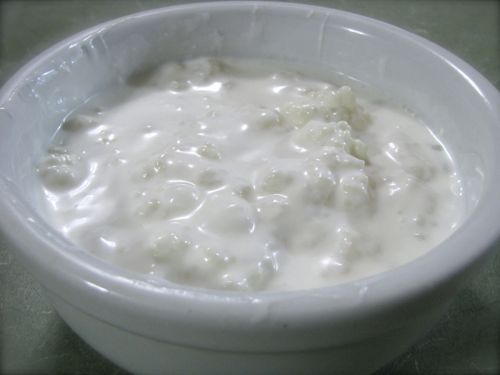
This is about three cups of dairy kefir grains, with some finished kefir surrounding them. Don’t they glow?! I had just taken the grains out of a finished batch of kefir. I usually don’t rinse them, just transfer to a new jar of milk.
It is winter, and the cooler temps make kefir growing a little different. For one, it takes longer. I am brewing my kefir for 48 hours instead of 18 to 24. We like it a little on the thick side, so it does taste more sour by the time I like the thickness.
For another, the kefir is a little stringy in the winter. Hopefully that doesn’t gross you out. 😉 There’s nothing bad about it, just pulling out the grains also brings a strand of finished kefir that breaks when it gets thin enough.
We love eating our kefir in various ways, especially in a kefir parfait; but sometimes just with maple syrup and cinnamon. Our kefir is thick enough to serve in a bowl, like pudding. We like it.
On the eCourse forum, a few members have mentioned taking less sour, yet more thin, kefir and straining it through cheesecloth to thicken it up yet keep its mild taste.
Back to those grains… I have been using all three cups to make 1/2 gallon of kefir every other day. I am growing them up to share with eCourse members, but also because the extra grains help make the kefir when the temps are more cool.
Also see: 7 Yummy Ways to Eat Kefir and What’s So Great About Kefir?
Have you noticed anything different with your kefir in the winter?
We only recommend products and services we wholeheartedly endorse. This post may contain special links through which we earn a small commission if you make a purchase (though your price is the same).


YAY for kefir grains! Mine are currently “resting” in the fridge… head colds are going around, and we’ve let up on the kefir for a few days.
I can’t wait to get to the kefir part of the course… I have “flavored” mine before with some ground nutmeg & cinnamon, and have been thinking about doing so with some pureed fruits, but adding maple syrup is something that I hadn’t thought of (and I don’t know why not!).
THREE CUPS OF GRAINS… I’m so jealous!
I’ve noticed in the winter that it does take longer to ferment, but I also get much larger grains. As far as the “stringiness” i notice that much more in the summer. In fact (this is kind of gross sounding, sorry!) it is almost like a super thick mucous. The first time I saw *that* I was worried that it was contaminated but it tasted fine. I just used my immersion blender (some people call it a stick blender) and gave it a quick whirl. That made the texture just fine. Once the weather cooled off, the grains went back to producing a “normal” texture. I’m looking forward to seeing if they do this again as the weather gets warmer, I’ve been making kefir for a little over a year, so last year was the first summer that we went thru together.
Peace,
Eriko
Your kefir grains look so healthy, so now it’s time to convert some of them to soda pop grains. I finally finished my post on, Converting Milk Kefir Grains. I hope everyone can understand what I wrote. If not let me know so I can explain it better.
.-= Marly´s last blog post… Converting Milk Kefir Grains =-.
When the weather gets colder, and the house is chilly, I find that my liquid kefir gets sort of thin and grainy. Not a problem. We have a little tiny stick blender that we buzz it up with! Beautiful grains, by the way!
I recently acquired a kefir based and majorly delicious Ranch dressing.
1 cup kefir
1 cup homemade mayonaise
1/2 – 1 tsp salt
1 tsp onion powder
1/2 tsp garlic powder
1/2 tsp dill
1/4 tsp black pepper
Whisk well, chill, serve and enjoy. I wish I could remember where this came from cuz it really is yummy.
Connie, I can’t thank you enough! I have been trying to break my 17-year-old from her Ranch habit (it’s one of her major food groups–she even puts it on spaghetti), and trying to break her Dad of buying it for her, so when I told him that we have a recipe for this, he responded with YAY! (I’m trying to get him to “buy in” more to the nutritional eating, and he says he is, but he is also his own worst enemy!) I can also see adding some nutritional yeast and maybe some kelp to this recipe (Wardee, you’re seasoned salt recipe has inspired me!).
Can’t wait to try this… Gonna go make some kefir now!
I have been using a kombucha heating pad system sold by the Happy Herbalist for the past 3 years. It may be a little pricey but when you keep your thermostat at 58 over night and 62 during the day…well… my kefir could easily get cold feet.
Here’s the link:
http://www.happyherbalist.com/heatingpanelreg.aspx
Like I said, it might be expensive but mine has been working for three years now and I expect to get at least a couple of more out of it. Any amortization calculator would tell you that’s not really a bad deal. Besides, my grains seem awful happy sitting on the pad all winter.
jed
Thank you so much for sharing all the info God has given you! Just curious if your grains ever separate into curds and whey? I like mine thick too, but it seems that if I leave them long enough to get thick, they will often separate before I have a chance to strain them! When I just shake everything back together, the resulting kefir is very thin. Any suggestions?
I would love to take your ecourse, but time doesn’t currently allow it. I do hope you will do it again!
I also have to share a funny story with you…
I had one grain that was huge; almost the size of a golf ball! I never really strained it, but rather just spooned it out and added more milk. So much easier than straining! One day I set it in the fridge knowing I wouldn’t have chance to add new milk until the next day. The next day, without thinking, I took what I thought was kefir out the fridge, poured it into the blender and made a delightful smoothie! Later, when I went to get out my golf ball sized grain, I couldn’t find it. I usually label everything so well! I realized at that point what I had done!! You can only imagine my horror! Fortunately, I had my reserve grains.
Michelle – That is so funny! And what a loss – I would grieve over that!
Michelle, I hope you drank those blended up keifr grains? You can do that you know. They’re very, very nutritious that way. I often just pop a grain into my mouth and chew away. It’s a little rubbery, but good. LOL Also if you didn’t drink them, I hope you put them back in your bottle with some milk, because they will kefir your milk just fine, and continue to grow. Also, did you know blended grains can be used in a high colonic to cure bowel problems? Just thought you’d want to know. LOL
Also, if you want thick kefir milk, culture it in your refrigerator, instead of on your counter top. It will take about 5 days, but will be thick and creamy. I whiz it up with my stick blender then, and make it even thicker, like whipped cream. Mmmmmm, yummy! But don’t forget to take out the grains first, unless, of course, you decide you want that colonic.
How similar is kefir to yogurt? I have been looking at buying either a countertop yogurt starter or kefir grains and was wondering which one would be better. What are the similarities between their tastes and textures?
LaniQ – They are similar, but kefir tends to be more sour and more effervescent and more thin. It is more beneficial overall because it contains more probiotics than yogurt – 5 to 10 times more I believe.
My grains seem to be culturing faster this winter. I guess I am the oddball. The kefir is a little grainy. It does seperate into curds and whey. I just shake it up when ready to use it. Sometimes I put it into cheesecloth and drain it to make kefir cheese.
Thank you, that is exactly what I wanted to know. I think my 2 year old would love it…if I would let him he would eat sour cream with a spoon! 🙂
Michelle – I never answered your question. I’m sorry! Yes, mine will separate into curds and whey if I let them go too long. 🙂 Right now the kefir goes 48 hours and there is just a bit of yellow whey at the bottom that mixes back in when I swish the jar around (after taking out the grains).
FINALLY! I’ve had a successful attempt at kefir…just this morning. I’ve been trying for weeks. Guess I’m not as patient as I thought I was. It took 38 hours to get it where I wanted it. I was only letting it set out for up to 24…it wasn’t very appetizing, let’s just put it that way. LOL! Now…even my kids will drink it. What a feeling of accomplishment! I’m doing a happy dance.
Thank you Wardee for your gentle encouragement all over this site and in the eCourse. I really appreciate all the effort you put into it…just so others can reap the same rewards.
.-= Tammy´s last blog post… It’s SOURDOUGH week in my kitchen! =-.
Alright, everyone; I’m trying my hand at kefir again, after having tried twice before. When culturing, my grains have tons of curd on them, and to get the curd off of them, I have to get pretty rough. The kefir is so thick and “curdy” that I have to really work to get it thru the strainer. Could I be damaging my grains? The bigger pieces seem to have broken up a bit, but I don’t think that’s a problem (I think of grains kinda like worms: if it breaks, it’s not like the heart is over here and the lungs are over there and now it’s been decapitated; no, it’ll still work, right?). Also, the kefir ends up being pretty runny after all that rough handling. I work long days, so typically get to stir or shake only morning and night, and it’s about 70 in our house, so it’s not like I have to let it sit out forever to finish culturing… It just doesn’t seem like it should be so hard to do this, and my grains aren’t nearly as beautiful as yours. (did I not mention in my earlier post that I am a little bit jealous of yours?)
Maybe I’m just supposed to leave more of the curd on the grains? it seems like there’s a LOT of curd, to the point that the grains can’t do their job because they’re not in good contact with the milk. *sigh* maybe I should just wait til this part in the ecourse!
Dani, please go over to my blog and read my “chapters” on kefir. http://www.simplyhomemaking60.blogspot.com
I think that will clear up some things.
I use a plastic strainer and sort of shake it up and down to drain the kefir. And the liquid kefir sits on the counter another 24 hours before we drink it. I think maybe you’re making this more difficult for yourself than is needed. Good luck.
Yolanda, I can’t WAIT to try your “kefir sourdough bread” from your 5th Kefir post. However, I LIKE my sourdough bread sour; can I let it rise longer or another rise to make it more sour? I can see adapting this recipe for biscuits, too! I think I’m going to check my kefir after 24 hours–usually, it’s still a pretty milk-like consistency, but with heavy curds on the grains. Of course, if I had any patience at all, I’d wait until we get to that part of the ecourse…
BTW, I meant to respond to LaniQ from a few posts back: Kefir has like 30-35 different probiotics in it (bacterium AND yeast, hence the grains; just like a Kombucha scoby); while yogurt, depending upon the strain, will usually have between 3-5, and bacteria-only biotics (no grains or scobys, so no yeast). The bacteria feed on the lactose in milk, whereas in kefir the bacteria and yeast are in symbios with each other (which is why it gets more and more cultured & sour the longer you ferment it). Kefir also has more folic acid in it, which is why I originally started making it; we were (and are again, after my recent return to health) trying to get pregnant and didn’t want a synthetic version.
Dani, I guess I don’t know what you mean by “curds on the grains.” To me, the grains ARE like curds. If you don’t wait another 24 hours (depending on the weather, of course) before you drink your kefir, it will not be AS good for you.
The sourdough kefir bread is not very sour. Just mildly. I do not know what would happen if you let it sit longer, as I’ve never done that.
Being somewhat new to the Kefir world I first tried fishing out my little Kefir grains by hand. Sure not very efficient and a little messy. Then I tried different strainers… I think you all know that strainers have their pros and cons. After meditating (LOL) over my little critters I doubled up some cheese cloth, made a bag about three times larger then the amount of grains I use, and tied the bag with a nylon string. When it’s time I lift my grains on the string out of the milk and a moment later they sit in the next batch of milk. No straining, no cleaning, no time wasted, and my Kefir is ready to drink or goes for second fermentation.
Once a week I hang my bag for about 30 minutes over my next batch of milk and let gravity do the job to drain the curd. As the curd is already fermented milk this batch is finished in about 70% of the normal time! Every few weeks I lovingly wash my “babies” and put them in a new bag. My grains get never disturbed or manhandled and they grow like crazy.
One thing you should avoid! Cut the end of the cheese cloth close to the knot of the bag. If the end of the cloth hangs out over the edge of the container the wick effect makes the ends dripping wet (and my loving wife was not to loving anymore).
Have fun and good health!
Hi, I am new here…first visit is today. I have been doing kefir for about a year….and LOVE IT! my question is this: you mention pulling out the grains…..what do you use to do this and how? I have only ever strained mine in a sieve over a bowl. If there is another way I’d love to know my options. Still browsing your site to see all the treasures it holds….looks wonderful!
Jayne — I just reach in with a spoon and retrieve them. They’re always floating at the top (for me) and the surface looks bubbly so I can tell just where they are.
Hi ! I had the same question about it. I’ve been making Kefir since a month ago and I wonder if those kefir grains that you take out with the spoon, are ALL the original kefir grains you once inserted? After you retrieve those, are there still kefir grains in the rest of the jar?
Normally I do what Jayne, use a strainer to separate as much as a I can my kefir grains from my kefir milk that is in some parts now solid, to be sure i don’t leave any kefir grains in the kefir milk.
I also had a question about “room temperature” terms, as I live in a city where room temeprature is really hot, I would like to know the normal room temperature you manage at your kitchen or where you let ferment kefir and milk kefir.
Thank you! =)
Danielle — They’re not always all the originals, because kefir grains grow. Sometimes a chunk will fall off. With my kefir, though, my grains tend to all float at the top and I find it easy to find them to scoop them up with a spoon. Others’ grains don’t float or they have lots of them and a strainer works well. You really just need to find what works best for you.
When I speak of room temperature, I mean right around 72 degrees F. Anything over 80 is a bit too hot for most ferments (though Kombucha likes it).