
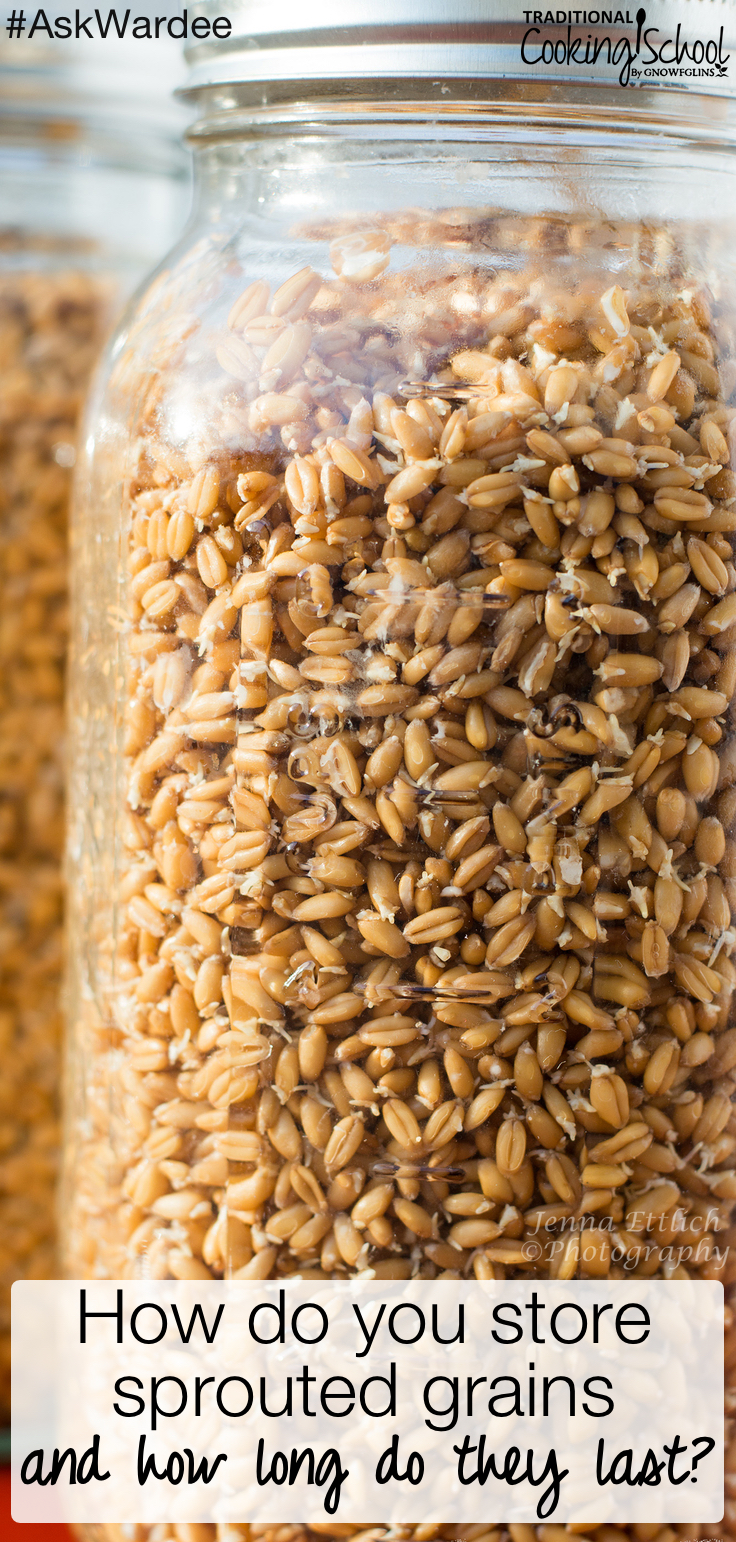
In Ask Wardee #149, we covered How to Store Flour and Grains. Today Sue asks, “How do you store sprouted grains, and how long do sprouted grains last?” Watch, listen, or read to find out the answer PLUS discover how sprouting grains makes baking cookies so easy — just mix and pop them in the oven! [by Wardee Harmon]
The Question
From Sue:
Would you please tell me how long dehydrated sprouted wheat grains last? What is the best way to store them? Since it is drier here in the winter, I would like to sprout and dehydrate a lot of grains.
Thank you,
Sue
My Answer:
Let’s say you want to make cookies or muffins. Prior to Traditional Cooking, you’d just get your ingredients, mix, and bake. Right?
But NOW, people like me say “No, no, no, no, no, no…. you need to SOAK THAT!”
Which means a delay. You can’t just go into the kitchen and make cookies. Or can you?
Yes, you can! One of the grain prep methods is sprouting. You sprout your whole grain berries, dehydrate until dry, and then make sprouted flour to use for those cookies!
You’re doing all the work up front. So then when you say, “I want to make cookies” you can actually … just bake them. No delay.
This is why I *love* sprouting and why we talk about it a lot inside Traditional Cooking School.
Why Sprout?
Sprouting is just 1 of the grain prep methods to make grains more digestible and nutritious.
It’s better than soaking but not quite as good as sourdough. However, it allows you to make your baked goods FAST because if your grain is pre-sprouted, it’s already prepped. Just mix and bake.
Learn how to sprout grains so you can make delicious sprouted pumpkin spice coffee cake and flaky and buttery sprouted spelt biscuits.
Storing Sprouted Grains/Flour
The process of sprouting converts the oil in the berries, making it less volatile and less susceptible to rancidity. Therefore, sprouted grains are somewhat easier to store.
You still store them the way you store your other grains — as airtight, dry, and dark as you can. Stored well, grains will keep many years. Sprouted grains are the same.
Sprouted Berries: Store airtight and as cool as you can, and they’ll keep for months. If storing longer, use cold storage or store in oxygen-free containers, such as vacuum-sealed.
Sprouted Flour: Grind only what you need to use. Store any unused flour in the fridge or freezer. Sprouted flour will keep in cold storage for a few weeks to a few months.
Links Mentioned:
- Free Traditional Cooking Video Series
- Sprouting Tutorials at Traditional Cooking School
Do you love having sprouted grains around for quick baking? How do you store sprouted grains and sprouted flour?
We only recommend products and services we wholeheartedly endorse. This post may contain special links through which we earn a small commission if you make a purchase (though your price is the same).


Sprouting grains has had huge health benefits in my home. Thanks for sharing more on this subject.
Has anyone ever tried freeze drying sprouted grains or legumes? I have a home freeze dryer and would like to try. I was wondering if then I could grind it into flour to use in baking.
I am following this as I have the same question. Though i am thinking maybe not as FD exceeds recommended temp for denaturing and dehydrating is quick enough. Would love to hear others thoughts.
Hi, Laura,
Please see my comment below. 🙂
~Peggy, TCS Customer Success Team
Hi Donna,
Here is a an article you might find helpful:
https://harvestright.com/blog/2021/sprouted-flour-made-easy/#:~:text=Freeze%20dry%20your%20grains.,in%20the%20refrigerator%20or%20freezer
~Peggy, TCS Customer Success Team
Once sprouted then dehydrated, and the endosperm has consumed the germ, is the vitamin E still the same and the same benefits to the body? Or has it been altered and become less beneficial? Thank you!
Hi, Carmela.
Here’s a link to an article by OneDegreeOrganics about sprouted grain.
https://onedegreeorganics.com/sprouted-grains-the-benefits-of-sprouting-everything-you-need-to-know/
Here’s an excerpt about vitamins and minerals in sprouted grains:
Sprouting breaks down antinutrients in whole grains, increasing the bioavailabilty of vitamins and minerals like zinc, iron, magnesium, phosphorous, and B vitamins2, so your body can absorb them.
In addition to breaking down antinutrients, sprouting also increases the amount of certain nutrients in whole grains—including antioxidant vitamins C and E, beta carotene, and polyphenol content.
~Makenzie, TCS Success Team