
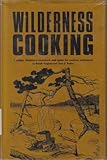
Every Monday, I pull out a meaningful quote from one of the great books or articles I’m reading (or re-reading) and share it with you. Today I’m going to share from an old book I picked up at my friend’s bookstore: Wilderness Cooking by Berndt Burglund and Clare E. Bolsby. It was written in 1973 by a husband and wife team who are wilderness experts, having spent their lives studying and teaching woodland lore. The bookjacket declares Mr. Berglund to be one of North America’s foremost authorities on wilderness life and survival.
Now you may be wondering why this book would interest me. Well, truth to be told, I got it because it would interest my husband. However, I am interested in the sourdough pages, and also the traditional meat curing and wilderness cooking techniques. Many of the recipes calls for wild edibles and the book features beautiful black and white drawings to illustrate most techniques – from the mud baking to the pit cooking. I enjoy flipping through it and choosing a page here and there to read. The more I read, the more I think, “That would be fun to try…”
I noticed a couple not-very-wilderness-like ingredients (milk powder and all-purpose flour). I’m choosing to ignore those and be tickled instead by the calls for “5 pounds bear meat” or “6 porcupine chops” or “4 wild onions” or “3 fingers bacon fat.”
The quote I am going to share today is from the Bread Baking: Wilderness Ways chapter, about sourdough. I know what they describe here is not fundamentally different from the way I go about maintaining and using a starter, but it feels different. Just for fun: note the hollow tree trunk!
Sourdough is kept alive by adding flour and warm water to the starter and letting it stand in a warm place overnight to ferment. The next morning you take out about a cup of the dough to use the next time you bake.
…
It is important to use a basic batter which is set the evening before you plan to make pancakes or bread. Take all the starter and put it in a bowl big enough to allow for expansion. The bowl should be earthen ware or stainless steel, or if you are on the trail a hollow tree trunk will do just as well. Add two cups of warm water (approximately 90 degrees F.) and two and a half cups of flour. Mix thoroughly. The mixture will be thick and lumpy but it will get thinner after 10 to 12 hours in a warm spot or close to the fire. Cover the bowl with a piece of waxed paper and a linen cloth.
The first thing to do the next morning is to take out a cup of the dough before you add anything to the dough and put it back in the sourdough pot. This is your starter for the next batch.
What feels different to me is a subtle shift in focus. I keep my starter going – and use some of it to make the dough. They use up their starter in the dough, and hold back some of it for the next baking. The way they describe the process sounds very… portable. (My starter bucket and larger quantity of starter takes up a great deal of space in the refrigerator.)
Because I want to give you more of a glimpse into this book, I’ll also quote what these wilderness experts share about the history of sourdough during the westward expansion of America.
When the country started to grow westward, the trail blazers, farmers, adventurers and gold seekers had one thing in common – the sourdough starter.
The famed and legendary sourdough pot on the back of the settler’s kitchen range, carried on the prospector’s back and in the chuck wagon of the wagon trains was always in evidence. Wherever there was a human being, there was also a pot of sourdough.
In other words, you could almost say the sourdough kept the nation growing.
Sourdough was highly prized and well taken care of in those early days. Losing it might well have meant travelling through the wilderness for many miles to the nearest settlement or trapper’s cabin to get some fresh starter.
What do you think? Fascinating isn’t it? Could you imagine making your dough in a hollow tree trunk?
Note: The book link in this post is an affiliate link to Amazon.com. If you choose to buy the book via my link, I’ll earn a commission. But I don’t care about that too much. The point of this post is for us to share inspirational words. That’s my sincere disclaimer. Thanks for reading.
Did you know? My Resources page shares sources for sourdough starters.
We only recommend products and services we wholeheartedly endorse. This post may contain special links through which we earn a small commission if you make a purchase (though your price is the same).


I don’t think I would have noticed that difference, but then I’m not making sourdough yet. Reserving a small portion does sound more manageable.
This reminds me of a passage in the Little House books —
“You start it,” said Ma, “by putting some flour and warm water in a jar and letting it stand till it sours.”
“Then when you use it, always leave a little,” said Laura, “And put in the scraps of biscuit dough, like this, and more warm water,” Laura put in the warm water, “and cover it,” she put the clean cloth and the plate on the jar, “and just set it in a warm place,” she set it in its place ion the shelf by the stove. “And it’s always ready to use, whenever you want it.” (By the Shores of Silver Lake)
What a fun book! Crazy how important sourdough was back then. I kind of feel that way about my ‘cultures’ now. 🙂 Of course, I can always have someone send me some over the mail instead of having to drive my wagons miles and miles. 🙂
I’m reading ‘Root Canal Cover-Up’ by George E. Meinig.
It’s absolutely fascinating. He was a dentist who taught how to do root canals and did a lot of them himself. He was even a part of the Price Pottenger Foundation for years, advocating good eating practices for teeth health and overall health. But it wasn’t until he found 2 of Price’s works on root canals did he realize his root canal works were actually making people sick instead of helping them. So many people would have hide such knowledge out or pride, but he saw the importance of getting such knowledge out to the public, so he did just that.
I think I read somewhere that the ADA revoked his dental practice license-but I can’t remember where, so don’t quote me on it.
It’s all about the 25 years of research that Price did on rabbits, that concluded that people with root canals, and other tooth issues, often suffered other degenerative diseases. And when the teeth were removed, many of those diseases went away. He took those same teeth and inserted them into the skin of rabbits and most came down with the same, or similar issues that the patient had whose tooth was implanted.
Here is a quote from page 120:
“What you know now, and what should be public knowledge, is that there is a much higher incidence of the occurrence of degenerative disease in those who have root canal fillings and periodontal gum disease than in those who maintain a healthy mouth. We must accept the fact bacteria find our tissues so attractive and desirable that they mutate and change form in order to survive there. At the same time we cannot ignore nutritional and metabolic effects upon our immune systems.
Dr. Price reported that, in a large number of cases, even when root filled teeth which appeared perfectly normal and without symptoms were extracted, a high percentage of the patients who had been experiencing heart problems found their conditions totally or almost totally subsided.”
My husband has awful teeth, and my 6 year old daughter has 4 cavities (not filled). And I’m hoping to figure out how to care for them without having to spend thousands of dollars, or make their health deteriorate. This is a very eye opening book, and quite easy to read.
Thanks for doing the Real Food Quote Mondays. I always look forward to them.
Sarah
.-= Sarah´s last blog post… Meal Plan Monday =-.
Christie – I love that quote! One of my favorites.
Sarah – That is fascinating! Have you read in the most recent WAPF quarterly journal – about dental health? They had recommendations in there for how to go about finding a holistic dentist. The advice was probably more general than what you’re reading though. But perhaps it would help your searching.
Thank you both for adding quotes to this post! 🙂 I always hope for that.
I don’t get the journal. I wish it was on-line for free. 🙂 I’m trying to learn as much as I can on dental health and healing, so I can make a plan of action for my husband. Finding a WAPF dentist would be nice, although not sure we could afford one. Like food, trying to balance the best of ‘both worlds’ and real life. 🙂
.-= Sarah´s last blog post… Meal Plan Monday =-.