
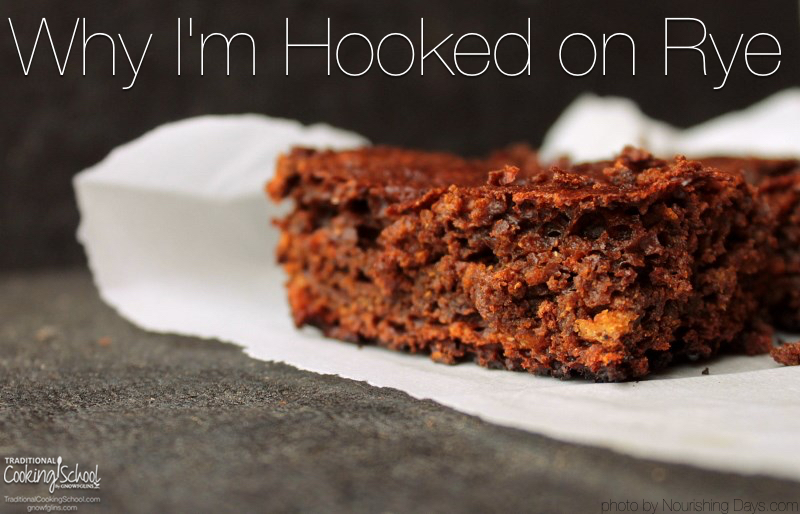
Note from Wardee: This is a guest post from my dear friend Shannon Stonger of Nourishing Days. I’m excited to help her unveil her brand-new (and amazingggggg) book 100% RYE. Here’s Shannon…
Though we now live off-grid, I once lived near a large city where many farmers and food artisans came to town weekly to distribute their traditional foods at a co-op. It was here that we purchased our weekly raw milk share, grass-fed meats, and eventually a rye bread that would change my bread-baking and eating habits forever.
This was a hearty loaf, so dark on the outside some might have mistaken it for burnt. But it wasn’t, it was perfectly cooked low and slow to create a thick outer crust. The tang was unmistakable and when I asked the baker – whom I would later take a sourdough class from – he nodded a knowing yes at my inquiry of a long fermentation time.
What really changed the way I looked at bread forever was what happened when I took that loaf home. My gluten-sensitive husband and son carefully nibbled on it and waited for hours and then days for a reaction. There was none. This long-fermented 100% rye sourdough bread was completely edible for them.
The coming years would see me churning out my own loaves, savory meal additions, and honey-sweetened treats, all wheat-free… but I’ll get to that in a minute. First I’d like to tell you why rye is such a great bread grain for our family — and maybe yours, too.
Rye: A Frugal, Traditional Choice
Eventually we moved and now live on an off-grid homestead far away from the convenience of the city, and the ability to buy this $7 loaf. So I started making a similar long-fermented 100% rye bread and, because rye flour was much less expensive than spelt and other heirloom grains, we saved a ton of money.
Rye has a long history as an inexpensive bread grain in European cultures. Weston Price himself, in his amazing work Nutrition & Physical Degeneration, commented on the health of the people of the Swiss Alps who subsisted primarily on a rye sourdough bread smeared with golden raw butter and served alongside raw milk.
Rye: Made Better with Sourdough
When I began experimenting with rye, I found that it had some serious idiosyncrasies. It can be gummy, especially if overworked, sliced before cooling, and made without sourdough.
Yet, sourdough and its acidity actually improved the texture of the bread. I suspect this has something to do with the type of protein found in rye, similar but not precisely the same as in wheat.
The acidity of sourdough, especially when fermented for 12 to 24 hours, created better texture. This coupled with rye’s ease of digestibility, inexpensive nature, and history as a nourishing grain of ancient cultures had me hooked.
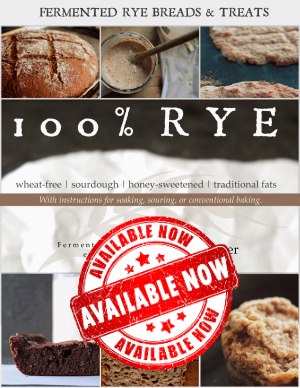
A Collection of Well-Loved, Fermented 100% Rye Breads & Treats
It took me one-and-a-half years to master these loaves, breads, and treats. I have four children, ages 1 to 8, whom we homeschool. We run an off-grid homestead with composting toilets, limited solar power, water-hauling and the whole bit. My husband and I both work in order to finance this sometimes not-so-simple life we lead.
So, like you, I don’t have time for complicated recipes involving fancy techniques and even fancier ingredients. As such, I formulated a Multi-Purpose No-Knead Dough and three recipes that use it — a simple loaf, a pizza crust, and an amazing focaccia we are very fond of. There’s a Sourdough Boule, savory additions like Sourdough Noodles and Sourdough Crackers with Garlic. There are also a host of breakfast foods and treats — all fermented, all wheat-free, all sweetened with honey.
I put these recipes together for our own family, and to suit our circumstances. But it occurred to me one day, as my recipe notebook got thicker and thicker, that they might be useful for others looking for wheat-free, fermented baked goods as well. So, to make it even more useful, I decided to create recipes that could be made fermented with sourdough, “soaked” with cultured dairy or dairy-free cultures, or made 100% Rye, with no fermentation at all.
These are the recipes that make up 100% RYE: Fermented Breads and Treats. They are recipes we continue to enjoy, and I hope you do, too.
Go here to download a sample and see the complete list of recipes in the book.

About Shannon
Shannon Stonger is a mama to four small children, homesteader, freelance writer, cookbook author, and fermented-food enthusiast. She is the author of three books: Simple Food for Winter, Simple Food for Spring, and 100% Rye. She also chronicles her family’s off-grid journey at Nourishing Days.
Do you love rye? What do you make with it? What can you share about it’s lovable qualities?
Wardee: If rye intrigues you (or you want to get better at baking with it and benefiting from it’s unique qualities), please help support Shannon’s work and her family by purchasing her new book 100% Rye. Thank you!
We only recommend products and services we wholeheartedly endorse. This post may contain special links through which we earn a small commission if you make a purchase (though your price is the same).


Shannon I will definitely take a look at your book! We’re not wheat free ~ we’re currently using a combination of spelt and einkorn for our sourdough breads but you’ve peaked my interest about the rye. And I love your description of “the not-so-simple life” I can so relate! Thanks for sharing.
I would like to have purchased this book but the sample recipe is using yeast! – I thought it was recipes made only with sourdough starter, and 100% rye. (sigh) – I continue to make bricks :>) when I use only sourdough starter and 100% whole grain Spelt, but I’ll keep trying. I understand that there is such a thing as autolyse which I will try next.
I’m wondering how our ancestors made edible, i.e. not brick like breads using only whole grain Spelt which is one of the heritage grains I like best. Suggestions welcome: traditionalcook.com
Hi Maria,
I’m afraid that sample download is a misrepresentation of the book! It was put up on the site by accident when all of the other recipes in the book except one utilize sourdough. I’m so sorry for the confusion!
I understand your frustration with the “bricks”. I think there are a few things at play here. For one, I’ve found that it takes some time to get a feel for whole grain sourdough baking. In baking with rye I found that a very high-hydration was necessary to avoid the brick scenario.
Now that I’m working more with wheat varieties, I find a similar principle to apply. The breads we have grown up making in which the dough is kneaded on a well-floured surface until it is not at all tacky is actually counterproductive, in my experience, to working with sourdough and whole grains.
Secondly, I don’t think it is out of the realm of possibilities to say that either a.) traditional cultures didn’t mind the denser bread because they had known nothing else or b.) they sifted a portion of their flour when they could. It takes a bit of time to do this yourself, at home, but it creates a lighter loaf, to be sure.
Hi Shannon:
Thanks for the tips and yes, I was finally able to talk with a whole grain baker who uses yeast and she too says that too much flour creates great bricks :>) – She advises that the dough must be pretty sticky regardless if you’re using sourdough starter or yeast. She also talked about making a poulish? Not sure that’s spelled right and not sure what the difference between a poulish and a sourdough starter?
I plan to bake another loaf of 100% Spelt and one of 100% Whole Wheat with more water. The discouraging part is that I have been faithfully following all the recipes including Wardee’s and tons of others, and they still come out like bricks.
So my question remains especially for newbie bakers if to even bother following any recipe book or on-line recipe verbatim! – Maybe recipes are only guidelines? I’ve been told that extra gluten would also help, not adding salt till the second rise, not allowing the second rise for than a 3 hours, etc. etc. Adding gluten is not WAPF, and so I am just going to keep trying and GREATLY appreciate any comments and or suggestions. I would even accept a phone call from a seasoned 100% whole grain sourdough baker.
Maria – traditionalcook.com
You mentioned in your article that your husband is gluten-sensitive and that he is able to consume rye with no problems. Do you know if that would also be the case with someone who has celiac? My son-in-law has been diagnosed with celiac and also has a sensitivity to corn, so my daughter (his wife) and I are always looking for foods that he can eat. If he could have rye bread, I’m sure he would be thrilled.
Gwen – I would be very cautious with someone who has been diagnosed as full-blown celiac. That said, many find that long-fermented breads are tolerated better, even wheat breads.
I don’t think you could know for sure unless you tried a long-fermented rye bread on him and it’s a pretty big risk to take. I’m sorry I can’t be of more help but I would rather be cautious if someone is severely allergic with celiac.
Thanks Wardee for introducing me to Shannon. I hopped over to her site and purchased the book. Yes, I love rye and glad to see it the shining star of Shannon’s book. There are ideas in Shannon’s book that I’d not made before, so am looking forward to trying them.
Besides baking with rye, I also love using it to make rejuvelac.
Jackie – Do you add anything except the rye to make rejuvelac? Sounds good!
Just sprout-able organic rye berries that have been sprouted til the little tails start showing. Then add filtered water and allow to ferment.
I understand you can make rejuvelac and just about any choice of grains, but I myself have so far just stuck with the rye because I like it and haven’t really had the curiosity (yet) to see what using other grains (or a mix) might end up tasting like. Sounds like another project to put on my lists, lol.
does rye not have phytic acid? Looks great!
I realised that I loved rye when I brought knackerbrod flerkorn thats when I knew what the flavour was. I nearly brought a pack of rye flour yesturday but dont have any recipes i will have to give this a go and have a look at your book thank you !